

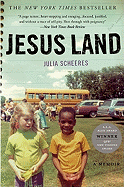
Their father, a physician, beat her two adopted brothers with belts and 2 x 4's: "Both boys' backs are riddled with welts, the fresh ones red, the old ones mottled gray, the deeper ones hardened into jagged scars . . . seeing their bare backs always makes my throat thicken, makes it hard to breathe." One December, angry that his older brother Jerome had been banished from the house, "David kicked the door shut . . . 'Just wait until your father gets home.' When his screams rise from the basement a few hours later, I wrap my head in a pillow and scream along with him. Christmas, Pat Boone on the stereo."
In 1985, when Julia and David were 15, the family moved to rural Indiana, and they attended a large public school, where David and Jerome were the only African Americans. Being so close to David, Julia thought of themselves as a unit, and would say that they were insulted with racial taunts because "they" were black. But in the new school, fissures appeared in their unity. She wanted to be someone other that "the black boys' sister."
The parents deem David a recalcitrant teenager and send him to Escuela Caribe to straighten him out. Julia follows not much later, after becoming a wayward child herself. When she arrives in the Dominican Republic on the way to the school, she is told that she can't see her brother. She starts to protest, but the teacher "lifts a hand to the dashboard and shoves a tape into the cassette player, and Sandi Patti's 'Lord Oh Lord, How Majestic Is Thy Name' bursts from the speakers and ricochets off the van's metal walls. It's the same tape Mother used to play to block us out in her van." Happy to be reunited with David, she soon discovers that his letters have been heavily censored and she has arrived in hell. "As Jay [the economics teacher] vomits evil at my brother, I stand and bear witness . . . when Jay slams his fist into my brother's stomach, my own breath is punched from me . . . I hold David's eyes for as long as I can and promise him that someday, we'll be free. Free and happy. Free together."
Called "filthy little sinners" by "the Pastor" (Gordon Blossom, who founded New Horizons Youth Ministries in 1971), they are crushed and punished until they are seen to have internalized the Program's values. The staff is made up of brutal people, perverting the name of God, who lie to themselves about what they are doing and why. They glory in constantly humiliating the students through derision, physical labor, corporal punishment. Julia quickly reached the point where anger was the only emotion she allowed herself. She went through the program "like a circus tiger, obeying commands . . . knowing that someday, my fangs and claws shall be useful once more."
Often the heartbreak is presented in a straightforward, dryly humorous way: "Maybe God's punishing me for not praying regularly. I used to pray all the time, but cut back when I didn't see results. Jerome didn't stop bothering me, Mother didn't get any happier, and my chest is still flat." At one point she realizes she needs a weapon in her bedroom, and finds a letter opener with a sharp tip, inscribed "I can do all things through Christ who strengthens me." Much of the power in her story comes from the gradual unfolding of circumstances, told in a plainspoken way that blindsides you with the reality of Julia and David's lives.
In Jesus Land, Julia Scheeres has written an intense, courageous memoir with brilliance and wit. It is filled with love for David, who clung to the ideal of a loving family in the face of beatings and abandonment. Julia was his family, and has created a memorial to him and to the finding of "small joys even in the bleakest of circumstances." This is a book that will hurt your heart but make it sing. It's a book that you will persuade people to buy, and will get much satisfaction out of selling.--Marilyn Dahl