

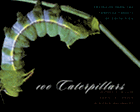
 This is a book to give to someone you want to impress with your keen gift-selecting skills--it will fascinate, delight and dazzle. People who didn't know they would be interested in caterpillars (of all things!) will become converts, entranced by the alluring names--Syssphinx mexicana, Cocytius lucifer, Adelpha celerio--and, above all, the extraordinary photographs. The caterpillars in this collection are found in Costa Rica, in the Area de Conservación Guanacaste, a World Heritage Site where the authors and gusaneros (caterpillar collectors and raisers) have been working for years. The caterpillars are aposematic, meaning they either warn predators away (or mimic the warning signs) by being poisonous, distasteful or painful to the touch; they are correspondingly resplendent in design. The photographs are accompanied by species accounts and images of the moths or butterflies these entrancing caterpillars become.
Dirphia avia is a wintry-looking confection of pomegranate red and ice white legs whose body sports snowflake-like appendages. As beige and brown adults, they have a garlic-like odor and are "so well protected chemically that if one is dropped in an army ant swarm, there is immediately an ant-free area around the moth." Xylophanes juanita has thoracic false eyespots that are striking, but the lavender and orange body with a purple jester's cap on one end is even more so. Guava trees are the home to Nystalea collaris, a deep coral colored caterpillar with a distorted body shape that looks like a torn leaf. The luminous green and fat Morpho polyphemus constructs a nest of leaves in which to rest, and its color pattern "seems to have been evolutionarily designed to avoid being noticed by a bird that has hastily torn into the mass of leaves and silk in search of any type of prey." Eudomia colubra is velvety black with jeweled markings that look like a suspension bridge. Lepidodes gallopava brings to mind a fuzzy green terrier, and when handled behaves like a piece of rotten wood, since "[its] goal in life simply not to be seen."
Some are, admittedly, creepy-looking, like the boa-ish Hemerplanes triptolemus or the cobra-ish Dynastor darius ("resembles some blob of dead plant tissue that has fallen into the dark abyss"), or the mummy-like Phocides lilea, with its scary false eyespots ("Go ahead, stare at that face and convince yourself that those are just random color patterns and not really a face with glaring eyes . . . wanting to make a lunch out of you."). Some are amusing--Manduca pellenia has a green and white striped body with a whimsical tail horn and looks almost cuddly. Manduca rustica, a relative, is blue, aqua and lavender, and resembles a pantomime horse on parade. Memphis pithyusa is a green and black caterpillar whose body is covered with little stars and planets. The tiny Calydna sturnula has a stunning pompadour of balloon setae, which secrete a chemical defense against predators. Fuzzy Trachon felderi, coral, black and white, is "absurdly gaudy and presumably possessed of a gallant stinging or toxic trick" and the utterly wild Morpho peleides looks like it was formed by a bickering committee (but then becomes a beautiful iridescent blue butterfly).
In Mary Oliver's poem "Great Moth Comes from His Papery Cage" she writes, "He is beautiful now, and shivers into the air/as if he has always known how,/who crawled and crawled, all summer./He has wide wings, with a flare at the bottom./ The moon excites him. The heat of the night excites him." After experiencing this book, you may be quoting poetry, too.--Marilyn Dahl