

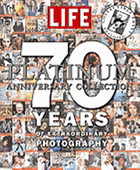
 LIFE magazine hit the stands November 1936 with "a deep-dyed affinity for the semicolon [and] and unswerving faith in photography and its power to educate, enlighten and entertain." Sometimes that lofty goal was compromised a bit, as in a 1937 photo-essay "explicating the proper way a wife should undress for her husband . . . LIFE was ready and willing to pander for popularity." Nevertheless, the popular magazine changed publishing history with its images and with writers like Norman Mailer and Ernest Hemingway, whose The Old Man and the Sea appeared in its entirety in 1952.
The frustration with collections like this is that they cannot capture all that we remember or want to see. The high points have to be enough; happily there are many of them in this book. "Significant and controversial imagery" has the most impact: Gordon Parks' street gangs; Margaret Bourke-White's death camps; Lennart Nilsson's images from within the womb; a mob rocking an out-of-state automobile during race riots in Tennessee or a black man in Birmingham, Ala., in 1963, where "A world of emotions cross this man's face as he stands battered but unbowed after a police hosing"; Dr. Albert Schweitzer in an African river canoe 1954; and a grand photograph of Noel Coward in the Nevada desert--he was at first reluctant, but photographer Loomis Dean persuaded him to pose "aided no end by booze, tonic and a tub of ice."
In various chapters we are treated to familiar images: W. Eugene Smith's "Dewey Defeats Truman," both Kennedy assassinations, James Dean walking through a rain-soaked Times Square, the classic Rita Hayworth pin-up, James Cagney dancing. War images are some of the better-known photographs: Robert Capa's falling Spanish soldier, Hitler at a Nazi rally, the Iwo Jima flag-raising, Korea, the Gulf War and Iraq, and a lesser-known, haunting 1941 photo of Jews murdered on the Russian Kerch Peninsula that was suppressed until the 1960s. In the science and nature chapter, a 1953 Yucca Flats atomic test picture is placed next to the eruption of Mount Saint Helens, and a 1995 shot of a Florida panther is annotated with a typically pithy caption: "Given Florida's roundheeled approach to development, the future of this species looks none too bright." Photographs by Ansel Adams and Jim Brandenburg, the awe-inspiring Hubble shots and Co Rentmeester's elegant Japanese snow monkeys are lovely. Of course, sports gets a chapter, wherein Jackie Robinson "strikes terror in the hearts of the Yankees en route to victory in the 1955 World Series," and a very provocative (okay, hot) photo of the 1996 U.S. water polo team raises the heart rate a bit.
The photo essays, from which many famous photographs have been excerpted in anthologies, are brilliant: Bourke-White's 1936 Montana, with taxi dancers shuffling for a nickel a song; Larry Burrows' series from 1965 Vietnam, "One Ride with Yankee Papa 13"; W. Eugene Smith's "Country Doctor," documenting Colorado physician Ernest Ceriani. The image of Ceriani leaning against a kitchen counter in white scrubs, coffee and cigarette in hand, is well-known, but the rest of the photos add depth and poignancy to the story: the doctor cradling a child's head who had been kicked by a horse and will lose her eye; kneeling on the floor tucking a blanket around a heart attack victim after phoning a priest; and in a rare moment of rest, watching a parade with his family.
LIFE: 70 Years of Extraordinary Photography is a wonderful collection both for readers who grew up with the magazine and for those who are unfamiliar with it; it's pretty much the perfect gift book.--Marilyn Dahl