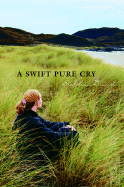
 Few writers can escape the influence of James Joyce--perhaps no Irish writer can. Dowd, an Irish author making her debut, uses his tools in her own unique style in a novel that sophisticated teens and Joyce aficionados alike will not want to miss. Set in 1984, her book begins with a quotation from the Sirens episode of Ulysses, referring to the phrase "swift pure cry" that Leopold Bloom uses to describe a perfect note sung by a sensuous woman ("It soared, a bird, it held its flight, a swift pure cry, soar silver orb it leaped serene, sustained"). For 15-year-old Michelle Talent, heroine of Dowd's story, the phrase refers to her mother's voice, dead just a year, whom she sorely misses ("A sudden heart-catching climax, the swift pure cry, her mam's singing along, soaring to the high note, peeling the spuds, hand-washing the woolens, turning to smile at Shell as she wiped her hands"). Other townsfolk compare Shell's beauty with her mother's, a comeliness that attracts the attentions of Declan Ronan. His family is wealthy; her family survives on the money Shell's alcoholic father skims from the church collections. The author weaves in themes familiar to Joyce fans: poverty versus wealth, the imposing presence of the Catholic Church, and sexuality--both budding and overblown. She also uses to great effect his device of repeated lyrical phrases to conjure a memory or to demonstrate the heroine's newfound sense of understanding as she navigates her world, like Bloom, largely alone. Declan comes between Shell and her only friend, whom Shell discovers too late has also caught his attentions ("Hickory dickory/ Bridie Quinn/ Ring the bell/ And let yourself in," he tells Shell). She discovers many things too late, and finds herself pregnant in a small rural town where rumors fly and choices are nil. But Dowd also conveys the ties between Shell and her younger siblings, and the kindness of a few neighbors; in each of them the author reveals some evidence of humanity. Readers know who the father of Shell's child is, but in a scene both climactic and cathartic, the heroine informs her father of the truth, and once again hears her mother's "swift, pure cry." Peace has come to Shell at last. Though nearly 80 years have passed from Joyce's Bloomsday (1904) to Shell's coming of age, Dowd suggests that not much had changed in Ireland. Its unforgiving beauty and hard-won independence lives on in the character of Shell and in Dowd's delicious prose.--Jennifer M. Brown

