

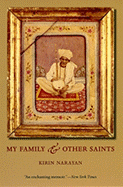

Born to an American mother and an Indian father, Narayan grew up in Bombay with her three older siblings in the late 1960s and early 1970s when Western obsession with Indian spirituality was at its height. Their beachfront home became a stopover for dozens of hippies and would-be seekers, prompting her mother to claim that it was known as a haven "all along the hash trail." Narayan's sari-wearing mother embraced all visitors and their spiritual quests while her father remained both cynical and skeptical, calling the houseguests "urugs" (backwards "gurus") and instructing mosquitoes to go "Off to a better reincarnation" as he slapped them from his leg. Spiritually and socially, Narayan and her siblings remained somewhere in between these poles.
In 1969, when she was 10, Narayan's brother Rahoul, who was 16, announced he was dropping out of school and going to live in an ashram. She sees this event (which bemused rather than alarmed her family) as setting the entire family in a slow-forward motion along their own spiritual journeys. She describes the next few years with fine impressionistic prose, weaving together her parents' disintegrating marriage, her father's descent into alcoholism and her brother's departure for the U.S. with visits to ashrams, friendships with gurus and tales from her paternal grandmother, Ba, who was visited regularly by Hindu deities.
Narayan's descriptions of India are particularly rich; from the banana milk she drank after school each day to the tie-dye shirts of the "urugs," her father's mounting Kingfisher beer bottles and her grandmother's pujas (devotions) to the Goddess Lakshmi. But it is in her questions of identity, both individual and familial, where Narayan's narrative attains real poignancy. As time moved forward, her family scattered (her mother to the foot of the Himalayas, she and her siblings to various cities in the U.S.) but remained bonded both by what she calls their "shared karma" and by their individual searches for higher meaning. Some of their stories end sadly or without resolution ("Who knows why I became a drunkard?" her father asks at the end of his life), but Narayan, a cultural anthropologist, finds the wonder and joy in her family's journey and presents it to us with insight and grace.--Debra Ginsberg