

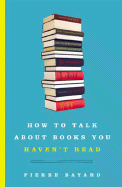
[Editor's Note: This is our second, more traditional take on this delightful, thought-provoking book.]

Contrary to its attention-grabbing title, Bayard's slim book isn't a glib instruction manual aimed at philistines hungry for quick tips to impress their more literate friends at cocktail parties. Instead, it's a thoughtful, often humorous, meditation on the myriad ways in which we encounter the written word and how the process by which we interact with text not only shapes our perceptions of an author's work but also ultimately transforms our inner lives in a true act of creativity.
For readers of a more practical bent, Bayard, a French psychoanalyst and professor of literature, cheerfully offers nonreaders a useful taxonomy of books and a handy set of abbreviations to identify them: UB--unknown books; SB--skimmed books; HB--books you've heard of; and FB--books you've read and forgotten. Too bold to stop there, Bayard even assigns each "unread" book a rating using a + and – scoring system, for, he concludes, "there is, after all, no reason for me to refrain from passing judgment on whatever books I come across, even if I have never heard of them before."
Drawing examples from writers as well-known as Montaigne, Balzac and Graham Greene and as obscure as Natsume Soseki and Pierre Siniac (UBs to this reader and I suspect most others), he illustrates what he identifies as "ways of not reading," sketches the sometimes harrowing "literary confrontations" that may require one to talk about an unread book and concludes with an elegant description of the enlightened state of mind that must be cultivated to enable readers to speak with conviction about even the most abstruse work.
At a time when the National Endowment for the Arts reports that fewer than half of all Americans read anything even charitably defined as "literature," it hardly seems we need any encouragement not to read. In that respect, Bayard's book may strike some as a subversive, even dangerous, work. Still, I doubt avid readers--a category I trust describes most subscribers to this publication--are likely to forsake any time soon the elemental pleasure that attaches to the simple act of curling up with a good book.--Harvey Freedenberg