


Ida and Louise Cook were born in the early 1900s, two ordinary Englishwomen with a quiet life in the London suburbs and jobs as a copying typist and civil servant. That all changed one day in 1923 when Louise heard a gramophone. She arrived home slightly dazed and said that she must have a gramophone. They scraped the money together and purchased it along with 10 records, including two recordings by Amelita Galli-Curci and Alma Gluck. They were transported by Galli-Curci's voice, and the next year, the sisters discovered opera, which became a lifelong obsession. The Cooks decided to hear Galli-Curci sing opera--in New York. They saved for two years, scrimping on food and clothes. They wrote to Galli-Curci, sailed to New York in 1926, and there and in London began meeting opera stars--Rosa Ponselle, Viorica Ursuleac, Clemens Krauss, Elisabeth Rethberg, Ezio Pinza and, after the war, Maria Callas. When they returned to London, Ida wanted to make a bit of extra money "and decided--like many a deluded creature before me--that the easiest thing might be to write something." Thus began the career of one of Mills & Boons' bestselling romance authors, under the name of Mary Burchell.
Then Hitler came into power. In 1934, Ursuleac asked the sisters if they would look after a friend of hers, and they took care of their first refugee. By 1935, they had "set our hand to the plough of practical assistance, and we did not look back until the war stopped us." They organized forged documents, cajoled civil servants into backdating letters and traveled the country to raise money and support, since England would take refugees only with guaranteed income or sponsorship. They traveled to Germany and Austria almost every weekend in the mid-1930s to meet with people trying to flee the Nazis and to smuggle out jewelry and furs that the refugees could sell in England. "The same naïve technique by which we had got ourselves to the States for our pleasure was used when we stumbled into Europe and began to save lives."
When World War II started, the Cooks' refugee work was over. They had been living amid great drama and urgency, and now, oddly, the war brought both boredom and release from tension. Until the Blitz, that is, when Ida volunteered to be a night warden at a shelter in Bermondsey. After one bad night in April, the air was filled with bits of charred paper: "The last of the big book centres in the City had been hit that night, and in the tremendous draught created by the fires, the remains of millions of books had been drawn up and now were drifting down, sometimes miles away in the outer suburbs."
After the war, they traveled again to New York, reuniting with refugees and prima donnas, happy to see a brighter future filled with life-sustaining music. Ida Cook's memoir was originally titled We Followed Our Stars, and they did--opera stars and stars of destiny. Their simplicity is affecting, their humility without pretense, their concern for others foremost. What had one refugee's "dear, good, useful life" cost them? "Some trouble, some eloquence and some money. Nothing more. The lack of proportion between the two is frightening." There we have it: two good women, bringing out the best in themselves and others, doing what needed to be done.--Marilyn Dahl
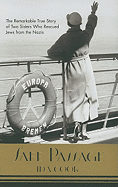
Shelf Talker: A memoir of two sisters, Ida and Louise Cook, who followed their passion for opera into a harrowing time of rescuing refugees from Nazi Germany. Their story is told by Ida with wit, warmth and humility.