

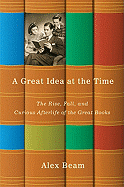
There's something oddly touching and quintessentially American about our country's passion for self-improvement. Meld that with the powerful engine of modern capitalism and you have the story of the Great Books movement, entertainingly recounted by Alex Beam in what he aptly describes as a "brief, engaging and undidactic history of the Great Books."
Beam offers lively portraits of an odd assortment of classics lovers like Thomas Hyland, the World War II pilot whose twin passions were described by his son as "reading Great Books and killing Japs." But readers like Hyland were too few in number, and instead of sparking a widespread American intellectual revival, Beam observes, many of the Great Books collections ended up serving as little more than attractive complements to the living room furniture. The rise of the civil rights movement and feminism further damaged the books' credibility, as the notion that all wisdom resided solely in the words of dead white men came under justifiable attack.
Despite that, Beam wryly concludes, "Against all odds, the Great Books movement is not dead." Great Books Groups continue to meet throughout the U.S., Columbia University offers core courses featuring the classics (David Denby's Great Books is a stimulating account of his reintroduction to that course as an adult), and St. John's College, the school founded in 1937 whose curriculum consists solely of the Western canon, still maintains two campuses.
In our time, when one of the worst charges that can be leveled against a political candidate is that he is an "elitist," the notion of average Americans stuffing their bookshelves with classic tomes seems quaint. Alex Beam's lighthearted, winning account is a reminder of a not so distant era when even people who weren't necessarily willing to devote the effort to be smart were prepared to invest the money to appear so.--Harvey Freedenberg
Shelf Talker: In this entertaining work of social and cultural history, journalist Alex Beam offers a lively account of the Great Books movement of the 1950s and 1960s.