

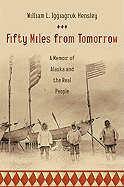
 During Sarah Palin's candidacy for Vice President, we were treated to a daily blizzard of stories, images and videos of Alaska (albeit mostly centered on Wasilla). If there is one positive aspect of that intense media focus, it is to bring the 49th state into our consciousness long enough to allow William Hensley's captivating memoir of the "real" Alaska a well-earned place on our bookshelves. With this book, Hensley, an Inuit who has spent much of his life advocating on behalf of the Iñupiaq, offers both a rich and engrossing narrative of his own life and a valuable resource in the effort to understand and protect the culture and history of Alaska Natives.
Born 18 years before Alaska became a state, Hensley grew up in Kotzebue, an area north of the Arctic Circle that at the time of his birth, counted its population in the hundreds. Life in "the twilight of the Stone Age" was difficult and narrowly focused on survival. Remembering his childhood, Hensley writes simply but in vivid detail of the hardships of daily life as well as of his deep love of family and traditional culture. In one passage, he offers a look at the construction and furnishings of the tiny sod dwellings that protected their inhabitants against bitter cold. Another fascinating section describes the critical role of dogs, always reflective of their owners, in all aspects of survival. "To those from the outside world," Hensley writes, "we may have seemed destitute, but . . . it was a good life." However, as Hensley relates, it was also an isolated life and when foreign microbes and processed foods were introduced by white "Outsiders," the toll on the health of the Iñupiaq was extreme.
From an early age, Hensley recognized the conscious efforts of educators and missionaries to "isolate children from their cultures." He carried this sense of injustice with him when he left Alaska to pursue his education in the Lower 48 and ultimately became an indefatigable champion of native rights. Hensley saw a great measure of victory in 1971 when, due in no small part to his efforts, President Nixon signed the Alaska Native Claims Settlement Act, which awarded 44 million acres and nearly $1 billion for use by Native Alaskans--the largest settlement of its kind in U.S. history.
Hensley continues his efforts to preserve and protect his native culture with this deeply respectful and clear-eyed book. Filled with Iñupiaq history and terminology (including a glossary and pronunciation key to the Iñupiaq language), Fifty Miles from Tomorrow is truly a window into the real Alaska.--Debra Ginsberg
Shelf Talker: An engrossing and vividly detailed memoir of the real Alaska from a fine storyteller and tireless advocate for the rights of Alaska's native people.