

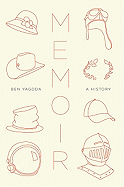
 With Sarah Palin crisscrossing the country hawking her new memoir, there couldn't be a better time to read a lively and thoughtful history of the genre like this one by University of Delaware professor Ben Yagoda.
After opening with a concise and often witty survey of the myriad subgenres that comprise our contemporary "Memoir Universe"--from canine chronicles to "shtick lit" (memoirs that describe a year pursuing some unusual project)--Yagoda turns to a chronological review of key turning points in the history of autobiography. From Caesar's Commentaries to celebrity tell-alls (almost invariably produced with the aid of a ghost writer) to gripping tales of family dysfunction, this account reveals a persistent fascination with the power of personal narrative.
A dominant theme is the existence of the frequently indistinct line in memoir between truth and fiction. Crediting Daniel Defoe as "one of the first authors to exploit the fact that human beings respond powerfully to narratives that are (or make credible claims to be) true," the three centuries of memoirs that followed often reflected that tension. Yagoda even detours briefly into the world of autobiographical fiction, contending that in works spanning the period from The Adventures of Huckleberry Finn to Philip Roth, "it's hard to find an important American novel that's not some variation on a memoir."
Yagoda also helps us recall that controversies over the veracity of memoirs like the one that swirled around James Frey's A Million Little Pieces (originally pitched as a novel and published only when represented as fact) are anything but new. He cites, in one of several prominent examples, the furor over Clifford Irving's faux Howard Hughes memoir that resulted in a jail sentence for the author (and spawned a movie Irving disavowed because it took too many liberties with the truth). Yagoda also pinpoints the roots of wildly popular memoirs like Angela's Ashes and Running with Scissors in Edmond Gosse's 1907 memoir, Father and Son: A Study of Conflicting Temperaments, which "prefigures the narrative of a beleaguered, constricted, abusive or otherwise troubled childhood."
According to the Modern Library, seven of the top 20 English-language nonfiction books of the 20th century are memoirs or autobiographies. Indeed, memoirs have become so ubiquitous they've even inspired at least one satirical novel, Brocke Clarke's hilarious An Arsonist's Guide to Writers' Homes in New England. With our obsessive interest in the lives of celebrities and the pervasiveness of an ethic of confession, the spigot won't be turned off any time soon. In such a literary world, Ben Yagoda's spirited, informative history will be a useful book to keep close at hand.--Harvey Freedenberg
Shelf Talker: Ben Yagoda's sharp and entertaining history of the memoir is essential reading as memoirs assume a dominant place in our literary culture.