

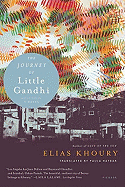
 Elias Khoury begins his most recent novel by listing all the characters on page one. The list continues over onto page two, the sentence ending by informing the reader that all of these people are dead.
That's not Khoury's only deviation from standard storytelling. Each of the seven chapters of this short novel begins the same way, announcing the death of the shoeshine man, with paragraphs repeating themselves and only the language varying a little. Little Gandhi, the shoe shiner outside the American University in Beirut, has been shot and has fallen dead over his shoeshine box. From this starting point, each chapter opens up in widening ripples to include a variety of other characters and stories-within-stories--in fact, the 194-page novel names more than 100 characters or almost a new character every two pages. That's a lot of characters.
Khoury's point, which he repeats in a refrain, is that the story is the characters. One incident reminds the unnamed narrator of another and yet another, beginning one here, ending one there, most of them first told to him by Alice, a 60-something prostitute in Beirut whose life has repeatedly crisscrossed through the shoeshine man's. However, Alice tells lies. There are holes in her story. You believe what you choose.
Why exactly is Abd al-Karim nicknamed Little Gandhi? It's never disclosed. As the well-meaning, heartful little man at the center of the multi-branching tale, Gandhi tries to solve the problem of the professor's dog (who dies) and his own mentally troubled daughter (who runs away) while trying to keep food on the table. His hands have become as black as the shoes he shines.
The cumulative effect of this kind of storytelling is powerful, and the interacting characters evolve to almost mythic proportions by the final sequences. Unfortunately, the last sentence of the novel is incomprehensible, and since it gives away no plot points, it is reprinted here: "When we knew the names, the story began, and when the names were extinguished, the story began." Though his philosophical underpinnings may be a bit bewildering, Khoury's depiction of a war-torn Beirut teeming with unforgettable characters makes unique, compelling fiction.--Nick DiMartino
Shelf Talker: A character-filled, compelling novel about the life and death of a shoeshine man in Beirut.