

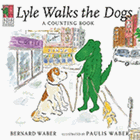

After more than a decade, Lyle the Crocodile is back, and with an occupation that suits him better than a desk job. Here author Bernard Waber, who has suffered from macular degeneration (which makes it hard for him to see details), partners with the person to whom he dedicated his first book starring the famous green hero, The House on East 88th Street (1961)--his daughter, Paulis Waber. Although the Primms do not make an appearance here, a street sign assures us that Lyle still lives on East 88th Street in New York City, and a final scene pictures him with Loretta the cat and Bird (with a few more yellow feathers).
The book begins on Lyle's first day as a dog walker, a profession essential to urban areas, but one with which children in rural and suburban areas may be less familiar. The Wabers quickly set the pattern for the pages to follow: "Day 1/ Lyle walks 1 dog./ The dog's name is Gwendolyn." Gwendolyn, who looks to be a yellow lab, is "frisky," says the text. "She pulls this way and she pulls that way." On Day 2, "Lyle walks 2 dogs. / Count them--1-2." The second dog, Morris, is "even friskier." When Pokey joins the group on Day 3, he earns his name and slows the pace a bit, and the fourth dog, actually named Frisky, wanders away from the group (albeit still on her leash) on many of the subsequent spreads. The Wabers introduce each pooch with a small framed picture and its name next to the day count, as they make their way to 10. There's affectionate Rosie (a Saint Bernard) and Snappy, who gets all the dogs sounding off ("Barking, as you know, can be quite contagious, especially for dogs"). As always, Bernard Waber offers young readers situations and emotions with which they can readily identify. Tulip, for instance, must "be coaxed out from under the couch. Everyone waited and waited for her." (Except Frisky, who's making mischief.) But as soon as Tulip joins the pack, she's "merrily wagging her tail with the best of them." On the 10th day, Sniffy the Dachshund, nose to the ground, discovers a squirrel, and the whole canine gang is off ("The dogs run. The squirrel runs. Lyle runs, too"). When they finally halt, Lyle asks readers to help him take stock: "Are all of the dogs here?" And the next spread shows all the canines' framed mug shots to help children count off. Lyle's management style keeps the dogs in line while still appreciating their diverse personalities. Part counting book, part gentle lesson in group participation, this labor of love between father and daughter will likely win over a new crowd of fans for Lyle.--Jennifer M. Brown