

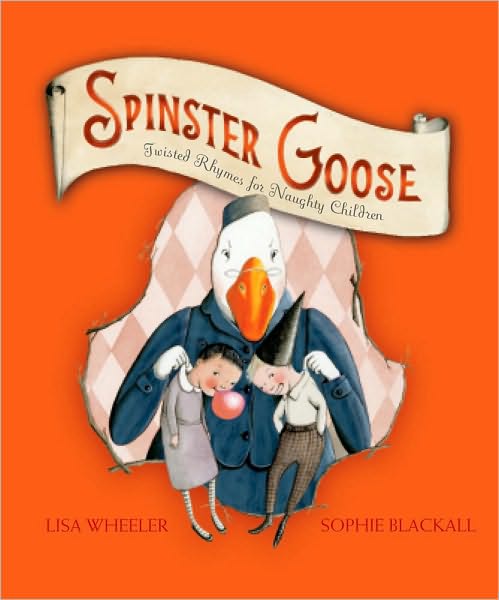
What child could resist a title like this? Everyone knows Mother Goose, but what of her spinster sibling who deals summarily with "naughty children" in a few choice soliloquies of her own?
Mother Goose, dressed in cheery checks and polka dots, introduces her severe-looking sister in the first poem as headmistress of a school "well designed/ to deal with uncouth urchins/ who have manners unrefined." Sophie Blackall (Big Red Lollipop; the Ivy and Bean books) lines up a handful of guilty-looking students, including an owl-headed boy and lamb-faced girl, and a pig-tailed human emitting a cloud of flatulence. Lisa Wheeler (Boogie Knights) sets up comical contrasts between the classic Mother Goose rhymes and the Spinster send-ups. The old standard ("Old Mother Goose,/ When she wanted to wander,/ Would ride through the air/ On a very fine gander") becomes "Old Spinster Goose/ never wanted to wander./ Instead, built a school,/ which is seated down yonder."
Slightly older children already familiar with the rhymes will most appreciate Wheeler's originality in such rhymes as "The Ditchers," starring Jack and Jill who have "ditch[ed] a boring class." In the second stanza, "When Jack fell down and broke his crown,/ Jill went to get the nurse./ Old Dame Dodd patched up his nod/ but that's when things got worse." Blackall pictures Old Dame Dodd as a Florence Nightingale–style frog, holding balloon-headed Jack and Jill by their necks. Across the gutter on the same spread in "The Bully," Georgie Porgie, rather than "kiss the girls," instead "poked preschoolers,/ took their ball./ Picked on people, weak and small." The artist casts George Porgie as a bulldog and dresses the preschoolers in union suits striped to resemble prison garb. She pulls the separate vignettes together by painting the preschoolers' ball the same blue as Jack's balloon head, and thus unifies the entire spread. A new spin on Mary with her little lamb as "The Fibber" ("Mary had a little lamb./ She said it was a horse./ But anyone with eyes could see/ it was a lamb, of course") and a hilarious satire of "Monday's Child" as the basis of a detention hall-studded cast of seven for the verse "Student of the Week" ("Monday's child insulted the tutors./ Tuesday's child hacked all the computers") are simply delicious. On the other hand, Mother Goose fans may be less likely to cotton to a rendition of "Baa Baa Black Sheep" ("The Swearer") that aces the first verse, then strays from the form by the third stanza.
Lesser-known rhymes such as "See Saw Margery Daw" often make terrific fodder for new interpretations: "Chew-chaw, Margery Daw./ This girl is a gum chewing master." The bubble-gum climax ("Oops!/ Too bad it exploded") culminates in Blackall's portrait of stunned Margery's face coated in tiny gobs of coagulated pink gum. Taking all of the 27 verses in sum, this is a stellar collection that will have children chanting in unison by the second or third read-through. Sure to become a dog-eared favorite.--Jennifer M. Brown