

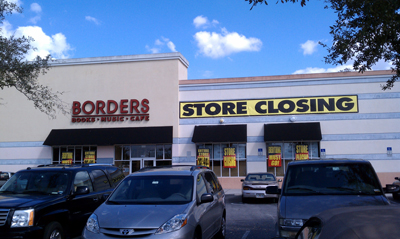
 Borders Group may close as many as 75 more stores beyond the 200
currently being shut down, CEO Mike Edwards said in a conference call
last Friday. The additional closings are dependent on rent reduction
negotiations with landlords; a decision on more store closings will be
made this week.
Borders Group may close as many as 75 more stores beyond the 200
currently being shut down, CEO Mike Edwards said in a conference call
last Friday. The additional closings are dependent on rent reduction
negotiations with landlords; a decision on more store closings will be
made this week.
The company is seeking lower rents from landlords
of all its remaining 285 superstores. The 75 additional stores that may
be closed are among 140 of what Evans called "on-the-bubble stores,"
whose lease terms may make them unprofitable. If Borders closes another
75 stores, it will have closed 56% of the superstores it operated when
it declared bankruptcy last month.
Borders "does not anticipate a
major closure program" involving its 148 small format and airport
stores, which Edwards described as "performing well." All of them won
lease concessions previously, he said.
The company's top 20
vendors, who represent 63% of last year's sales, are shipping, "mostly
cash on shipment," Edwards said. He called normalized trade terms
"critical in the company's success" and wants those to be restored. He
also called it critical for Borders to be able to return books
"consistent with our ordinary business practices" and said that Borders
is having "individual discussions" with major publishers about returns.
Borders
continues to work on a strategic plan, which it will review with the
unsecured creditors' committee in early April. Major elements will
include "the refresh merchandise strategy, a new commitment to e-books
and e-commerce as well as an enhanced store layout."
CFO Scott
Henry said that sales at stores that will remain open have "exceeded
expectation." The company has "more than adequate liquidity" and is
paying all vendors and landlords "on time and consistent with their
individual terms."
Henry added that Borders wants to work with
all its business partners "to review our current relationships" to see
how they can be made more cost effective.
---
 Borders hopes to emerge from
Chapter 11 by the end of the summer in time to be ready for the holiday season,
Edwards told the Wall Street Journal in his first interview since the company
filed for bankruptcy.
Borders hopes to emerge from
Chapter 11 by the end of the summer in time to be ready for the holiday season,
Edwards told the Wall Street Journal in his first interview since the company
filed for bankruptcy.
Noting that companies that have failed in Chapter 11 held on to money-losing stores too long, he said, "You've got a window, and you have to move decisively."
Borders aims to reconfigure stores so that about 15,000 square feet of the average 25,000-sq.-ft. store will be devoted to books. The rest of the stores will likely be shared by cafes, children's books and educational toys and games and consumer electronic products. The company may also add used books, which are doing well online.
Borders will continue to sell a variety of e-readers, but in exchange for receiving a share of all Kobo e-book sales in the U.S., Borders will emphasize the Kobo in its stores and online.
Concerning the unsecured creditors' committee's objections to Borders's bankruptcy financing made last week in court papers, Edwards told the paper that Borders is "confident that we have negotiated the best financing for our situation."
The committee said that the company won't have enough money to place orders for the fall season "and will have to either find new investors or sell itself by mid to late June," the Journal wrote. At the same time, it said that the $505 million made available by GE and other lenders was more than needed, "resulting in about $16 million in unnecessary fees," the Journal wrote. But formulas with the financing "make it unlikely that Borders will be able to borrow the full amount."
Borders responded that it has made several changes to its financing terms after consulting with creditors, the Journal wrote. "The remaining objections by the committee amount to a 'wish list,' Borders said, that were already discussed as part of 'hard bargaining' between the company and its lenders before the bankruptcy filing."