

When artist-turned-author Michael Burke needed a name for the main character in his mystery series, he had one at the ready. As a child, he wanted to change his own name to Blue Heron after a sighting of the magnificent bird. He stuck with his given moniker but, decades later, knew what to call the detective in his debut novel, Swan Dive (Pleasure Boat Studio/Caravel, $15, 9781929355501), and its follow-up, Music of the Spheres ($16, 9781929355709).
 John "Blue" Heron is a down-on-his-luck
private investigator in a derelict New England industrial town. A study in
contrasts, he lives in a run-down apartment building dubbed the Dung Hill Arms and
drinks carefully crafted martinis (gin, two drops of vermouth, a twist of lemon
and lots of ice). He's a daydreamer and a bit of a slacker who ruminates on the
nature of the universe and has Wagner's "Ride of the Valkyries" as
his cellphone ringtone.
John "Blue" Heron is a down-on-his-luck
private investigator in a derelict New England industrial town. A study in
contrasts, he lives in a run-down apartment building dubbed the Dung Hill Arms and
drinks carefully crafted martinis (gin, two drops of vermouth, a twist of lemon
and lots of ice). He's a daydreamer and a bit of a slacker who ruminates on the
nature of the universe and has Wagner's "Ride of the Valkyries" as
his cellphone ringtone.
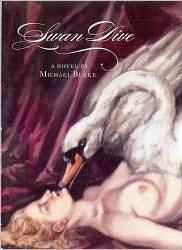
Gritty, witty and unabashedly racy, the books have garnered Burke comparisons to Dashiell Hammett, Raymond Chandler and Mickey Spillane--with a twist. He intertwines the hardboiled storylines with elements of mythology and astronomy. "I like the idea of giving readers something else to think about," said Burke. Swan Dive is loosely based on the Greek myth of Leda and the Swan, with Blue navigating an intricate web of family deceit and treachery. (The book's cover features a painting by an artist friend of the author.)
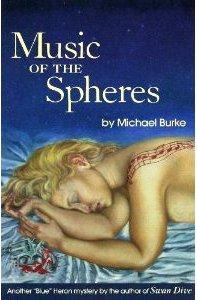 In Blue's second adventure, despite
a few threats on his life, he refuses to quit until he cracks a seemingly
unsolvable case involving blackmail, infidelity and murder. The tome's title derives
from the Pythagorean concept of the Music of the Spheres, "a harmony,
musical notes of frequencies created by the rotation of the planets," muses
Blue while staring out over the railroad yards by his apartment and gazing at
the night sky. It's also the name of a stage act put on by Stella Starlight, a
stripper Blue befriends and beds.
In Blue's second adventure, despite
a few threats on his life, he refuses to quit until he cracks a seemingly
unsolvable case involving blackmail, infidelity and murder. The tome's title derives
from the Pythagorean concept of the Music of the Spheres, "a harmony,
musical notes of frequencies created by the rotation of the planets," muses
Blue while staring out over the railroad yards by his apartment and gazing at
the night sky. It's also the name of a stage act put on by Stella Starlight, a
stripper Blue befriends and beds.
Looking to the heavens for inspiration on plot points came naturally for Burke. After graduating from Harvard with an architectural sciences degree and doing a stint in the Army, he embarked on a career as an astronomer and spent several years with the Smithsonian Astrophysical Observatory in far-flung locales like Hawaii and Iran. He then earned a Master's in urban planning from Columbia University and worked as a transportation planner in New York City, where he currently lives.
Burke's career path took a dramatic turn 35 years ago when he decided to become an artist. "It was either a very brave thing to do or a total copout--probably a combination of both," he said. Some of his sculptures, prints and drawings incorporate scientific concepts or mathematical equations, intriguing enhancements to the works rather than their focus. "I never want someone to look at it and think they're going to have to take a test," explained Burke. His pieces are in private collections and on display at various museums and libraries, including the Biblioteca Nazionale in Florence, Italy, and the Paterno Library at Penn State University.
 Swan Dive wasn't the
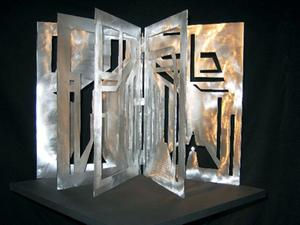
first page-turner Burke produced. His portfolio includes a series of book sculptures
crafted from aluminum. The pieces, which range in height from 14 inches to six
feet, feature four or five hand-cut pages and usually have a mathematical theme.
They open and close like traditional books and can be positioned upright for
display.
Swan Dive wasn't the
first page-turner Burke produced. His portfolio includes a series of book sculptures
crafted from aluminum. The pieces, which range in height from 14 inches to six
feet, feature four or five hand-cut pages and usually have a mathematical theme.
They open and close like traditional books and can be positioned upright for
display.
Burke's creative endeavors were influenced both by his mother, an artist and mathematician, and his father, philosopher Kenneth Burke. After his father declared himself to be an "agro-bohemian," the family relocated from New York City to a farmhouse in a rural section of northwestern New Jersey. He said, "I grew up out there without any plumbing, without any electricity, and no heating. No phone. We pumped our own water. It sounds very much like Abe Lincoln." William Carlos Williams, Ralph Ellison and other notables were frequent guests. In the outhouse was a wire toilet paper holder made by sculptor Alexander Calder--a hand with the middle finger sticking up to hold the roll of tissue.
In high school and college, Burke struggled with writing and never envisioned that he would become a novelist. Blue came into being while he was on an extended visit to India, where his wife, a teacher, was studying literature. The couple lived in an apartment for a month in Mumbai, and he began feeling claustrophobic in the intensely crowded city. "I started to go a little crazy in a way," he said. "I was not centered at all." He channeled his anxiety into middle-of-the-night writing sessions.
Burke wrote what eventually became chapter 17 of Swan Dive, "an over-the-top sex scene," he said. "I liked it so much I had to figure out a whole plot to go around it. I'm not a writer, but I've always been a problem solver. Even sculptures I set up as problems. So the whole thing turned out to be one huge problem: how to keep this scene in the book and make it work."
Most of Swan Dive and Music of the Spheres were written at the family homestead in New Jersey, where Burke and a bevy of relatives regularly convene. (There is now electricity and plumbing.) A third mystery is in the works, with four random chapters completed so far. "In a sense, I'm doing the same kind of thing," Burke said. "I've given myself a problem. I have to take these four totally disconnected chapters and make them into a book."
After finishing Swan Dive, one reader commented that she recognized traces of the author in Blue. Although the novel is not autobiographical, Burke did confess to two sharing two traits with his fictional detective. "I'm a total daydreamer," he said. "And I drink martinis. Just make sure they're very dry." --Shannon McKenna Schmidt