

Norton Juster and Jules Feiffer stole the show at the 40th Annual BookFest, held at recently at Bank Street College of Education in New York City. The longtime friends and collaborators touched on everything from education to creativity born out of necessity to the importance of breaking the rules. Children's literature scholar Leonard S. Marcus, who wrote the annotations for The Annotated Phantom Tollbooth, published last month in honor of the novel's 50th anniversary, moderated the discussion.
|
Juster, Marcus and Feiffer on the steps of the Brooklyn brownstone where author and artist met.
|

"I grew up in the Bronx during the Great Depression. There was class warfare," Feiffer began his critique of education. "Teachers versus kids, and kids versus teachers. You gave teachers the answers you thought they wanted, and did that until you graduated and started your real life." Juster didn't like school either, and summed up education this way: "There's a wonderful Peanuts strip in which a child says, 'What does it mean?' And the classmate answers, 'Somebody tells you.' "
Feiffer's breakthrough came with the discovery of comics. "Letters didn't make sense to me," he said. "But when comics came along, the combination of words and pictures made it so I could understand better the stories being told." Juster, who became an architect, described his early challenges with math. "I had synesthesia--I couldn't do numbers if I didn't have colors," Juster explained. This began his interest in "translating things differently from what was intended," such as how words or letters taste. He added, "There is no one way to look at anything, which is the opposite of what we learned in school." Feiffer chimed in, "There's something to be said in favor of brain damage. Something kept us from integrating. Either we understood rarely, or differently from everyone else. That created habits of thinking--around the box, outside of the box--thinking in a sub rosa way."
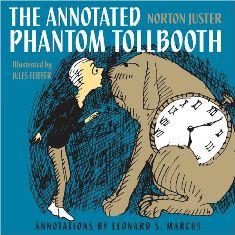 The collaborators met while taking out the trash in the Brooklyn brownstone that they both called home. They immediately discovered they were of like minds. Juster took a slight detour from his plan to become an architect, thanks to a grant from the Ford Foundation. He began writing a story littered with puns that evolved into The Phantom Tollbooth. He credits his father as the big influence on the punning. When he had about 50 pages, Feiffer's wife offered to give them to her editor--Jason Epstein. "Jules started drawing little pictures," said Juster. "They were so good, the publisher couldn't ignore them." Feiffer added, "Norman's book had a wit that seemed to be an extension of our normal conversation. It seemed to be a natural that I would play with it." Juster tried to stump Feiffer at times, forcing him to draw horses, which Feiffer felt he was not good at, and Feiffer got his revenge by drawing Juster as the weatherman. "It was a game within a game," Juster said.
Feiffer expressed his concern that our society doesn't value this kind of battle of wits. In times of economic distress, the first cuts are in education and libraries. "There's a deep root of anti-intellectualism, a hostility toward learning things you don't already know," Feiffer said. Ever the kidder, Juster added, "Everyone's worried about education, but it's really the appearance of education and the credentials of education they're worried about. I think at birth we should give every child a Ph.D."
Feiffer maintained that the real education when he was growing up happened through popular culture. "There was music that taught us about broken hearts. Bing Crosby and Bob Eberly, before Sinatra came along," explained Feiffer. "And the movie musicals, along with the radio programs at the time, educated us in a sense of optimism in these rough times that we had. That's lacking today."
Feiffer noticed that the kids he meets now seem to be afraid of breaking the rules. "The first thing I do is give them a license to fail," said Feiffer. Lacking teachers they admired, Juster and Feiffer seemed more than ready to step into the role. --Jennifer M. Brown