

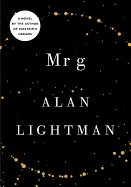
 "As I remember, I had just woken up from a nap when I decided to create the universe." From that offhanded beginning, Alan Lightman spins a beguiling tale of the birth of a universe called Aalam-104729, which bears a striking resemblance to our own, as told from the perspective of none other than the Creator himself, a humble character known only as Mr g.
Mr g. shares the Void with two bickering relatives, Aunt Penelope and Uncle Deva, who are skeptical about the wisdom of their nephew's decision to disturb their eternal slumber to create his science project. They're a pair of kibitzers, second-guessing nearly every detail of his audacious undertaking. The Creator's most intriguing conversations are reserved for a being known as Belhor, who jousts with him on the subjects of free will, the nature of good and evil, and the problem of human suffering, all poignantly summed up in the story of a young girl observed stealing food to feed her starving family.
There's nothing dogmatic about Lightman's approach to his material. One hears familiar echoes of the biblical creation narrative when Mr. g "created darkness and light" and "decided that these things were also good," but the novel refers only obliquely to some of the elements of that story. Mr g studiously avoids intervening in the workings of his universe, instead establishing three fundamental laws (symmetry, relativity and causality), and then setting it in motion so that everything "happened on its own by trial and error, with no need for meddling by outside parties." There are even moments of humor, as when an impatient Creator decides to perform an "experiment" to speed up the process by which consciousness emerged from "billions of planetary years" to "mere moments."
As he demonstrated in his 1992 bestseller, Einstein's Dreams, Lightman is able to write with the keen insight of a scientist and the lyricism of a poet. From describing newly formed matter in the shape of "ellipsoids and spheroids and topological hyperboloids" to imagining the oceans, with their "liquid waves" that "glided across the surfaces, crest to trough to crest, glittering with starlight and reflecting the colored atmospheres above," he brilliantly conveys a sense of the awesome power and mystery of the universe's origins.
Whether you are a believer, an atheist or occupy some position in between, if you approach it with an open mind you are certain to find something worth pondering in this delightfully original novel. Who knew cosmology could be such a blast? --Harvey Freedenberg
Shelf Talker: Theoretical physicist Alan Lightman offers a beguiling version of the Creation, as told by God himself.