

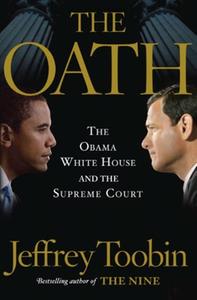
 In The Oath, journalist and attorney Jeffrey Toobin takes up where his 2007 book, The Nine, leaves off, to paint a portrait of the activist Supreme Court headed since 2005 by Chief Justice John Roberts, whose treatment of judicial precedent has been anything but conservative.
The foundation of Toobin's reportage is his interviews with the justices and more than 40 of their law clerks. The insights he gleans from these conversations, including the light they shed on the personal relationships among the justices (highlighted by the unlikely friendships between Scalia and his Democratic colleagues Ginsburg and Kagan) and their sharply divergent judicial philosophies, make for lively reading.
But the liberal-leaning Toobin offers much more than an inside-the-robing room tell-all; his research points him to a disturbing conclusion about where the law is headed as long as the Roberts/Scalia/Kennedy/Thomas/Alito bloc remains intact. Whether it's recognizing an individual right to bear arms under the Second Amendment, sharply limiting the desegregation efforts of school districts in Seattle and Louisville, or unleashing a flood of corporate campaign donations with the Citizens United decision, Toobin points out how, time and again, in the name of trying to divine the original meaning of the Constitution's text, the Court's conservative wing (led by an increasingly partisan Antonin Scalia) has overturned interpretations of the document that have been settled for decades. He goes so far as to call it a "war on precedent," noting that if Clarence Thomas, whose wife, Ginni, lobbied extensively against health care reform, has his way, decades of case law upholding legislation intended to promote public health and welfare under the Constitution's commerce clause--not to mention the right to legal abortion recognized in Roe v. Wade--could be erased.
The book concludes with a timely discussion of the Court's late June ruling upholding the Affordable Care Act. While Roberts's deciding vote based on the federal government's taxing power subjected him to savage criticism from the right, Toobin suggests it was "folly to pretend that Roberts had discovered his inner moderate." Instead, Toobin argues, that vote ultimately may serve to provide cover for the Court's conservative majority against attacks from liberals.
With four of the nine justices aged 74 or older, the odds are high that the president elected in 2012 will have a chance to fill at least one or two vacancies. After reading Toobin's clear-eyed book, it should be apparent to any thoughtful reader why those choices could be fateful ones. --Harvey Freedenberg
Shelf Talker: Jeffrey Toobin takes a look at the early years of the Roberts Court and finds its activist bent at odds with conservative rhetoric.