

Small Demons isn't intended to be a recommendation engine, Richard Nash, the company's v-p of community and content, insisted during a panel discussion at Digital Book World's "Discoverability and Marketing" conference. Instead, he described it as "a Borgesian map of the universe," elaborating: "What I'd say we're interested in is creating as much serendipity as discovery." By cataloguing the cultural references--people, places and things--that occur in a growing library of books, then inviting people to learn which books mention the things they're curious about, Nash eventually hopes to be able to offer publishers "a remarkable psychographic of your audience" and the characters and brands that resonate with them.
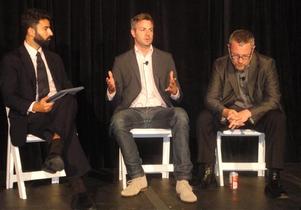 |
| Digital Book World editorial director Jeremy Greenfield with Patrick Brown of Goodreads and Richard Nash of Small Demons. |
Understanding the audience was a significant theme of the two-day conference; in an early presentation, Bowker v-p Kelly Gallagher rejected the notion of the middle-aged housewife as archetypal book buyer as too simplistic: "Unless you really know who she is," Gallagher warned, "you're not going to get very far." It's not just about understanding customer psychology, though, but also exploiting it, as WildFire Marketing's Rob Eagar exhorted publishers to stop trying to sell books based on what they're "about" and start talking about "what's in it" for the consumer, while Charles Duhgg, the author of The Power of Habit, proposed a need for stronger "reward" cycles to get people hooked on reading.
Amazon's director of author and publisher relations, Jon Fine, talked up the benefits of his company's Author Central program and the benefits to publishers of allowing consumers to search inside the entire text of a book. Fine also announced that authors will now be able to integrate their Facebook page with their Amazon author page, boosting discoverability. Barnes & Noble digital marketing v-p Sasha Norkin's insight on marketing through the Nook could be summarized as encouraging publishers to submit "a great book with a great cover--something grabby" to B&N's promotional programs. Several other panels had very meaty tips, especially when it came to strengthening metadata, from how long a headline can be before it gets cut off in a Google listing (65 characters), or a breakdown in the differences in the volume of search queries for blockbuster titles versus sleeper hits, to a reminder that including ALT text in the meta tags for your online images will improve your search results.
Not all the information coming out of the conference was upbeat, however: Gallagher reported, for example, 21% of book consumers in a recent survey had said they'd bought fewer books in 2011 than the previous year. Even here, though, there were some glimmers of hope: 32% of book buyers were making their purchases in physical bookstores (265 at chains, 6% at indies), and 19% of book purchases were prompted by in-store displays. (And, he added, physical stores are better venues for generating impulse purchases; online consumers tend to come looking for specific titles and stop shopping once they've found them.) He also observed that 4% of book purchases come from recommendations by in-store staff. That might not seem like a lot, especially in the growing shadow of what Goodreads community manager Patrick Brown described as his site's "bubbling cauldron of word of mouth," but it's an excellent starting point. Local booksellers, after all, are in an excellent position to learn about their customers' individual reading profiles--and to know about the books that might fit their tastes. --Ron Hogan