

The concept of discovery was one of the leading themes of Digital Book World's programming yesterday.
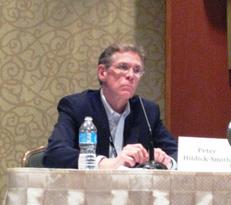 Discovery plus conversion ("Is the book interesting enough to buy?") plus availability equals new book sales, explained Peter Hildick-Smith, founder and CEO, Codex Group, which surveys about 3,000 unique book buyers monthly.
In the past, he said, physical stores delivered significant discovery, but now there is a "decoupling" of availability and discovery. In June 2010, 32% cited physical bookstores as a main discovery source; by December 2012, that percentage had dropped to 20%. However, he noted, the online retail space is just not helping readers discover books, even though the large players (Google, iBooks, etc.) have spent an enormous amount--$1.4 billion--in advertising to move book buyers into digital.
According to Codex, bookstores' share of purchases has declined significantly: 65% in November 2010; in December 2012, 39% of purchases were in physical stores. However, at the same time, there is a "massive online discovery gap": online retailers' discovery percentage is only 7%, compared to 20% for physical stores.
Codex's surveys show that 53% of people who shop at a physical store go to find new books and new authors. Physical stores sell a more balanced mix of fiction and nonfiction, while e-book bestsellers skew toward general fiction and genre fiction.
"Physical retail works if you protect it. Movie producers do [protect theaters]. I would argue publishers are not doing enough to help bookstores," Hildick-Smith said.
 Jim Hilt, B&N's v-p of e-books, noted that the "explosion of players in the tablet marketplace has fundamentally changed the way we sell books." He said that 20% of readers--"power readers"--drive the marketplace.
He, too, talked about the discovery challenge: "There are millions of books and millions of pieces of content competing for the attention of the reader. Our biggest challenge... is that the mindset of the consumer is distracted.... With 3.5-4 million books out there, how do we shift the paradigm of book discovery? Discovery is about interest, not category. What are you interested in? And how do I put those books in front of you?
"So much is new that is old," he said; "much of what we know about bookselling can be applied to digital." For example:
- Literary fiction = not so easy to read
- Recommendations from friends make the sale
- Fantasy readers can read endlessly. They are always engaged, discovering new content, and their behavior is the same online as in stores. "Our task here is to help them sift through content."
Hilt said, "There is still nothing better than going in to a bookstore and talking to someone who knows books. But how do we translate that to the digital space?"
Sharon Lubrano, Bowker general manager and v-p, discussed results from Bowker's survey of 6,000 unique book buyers each month.
- 23% of all books purchased were e-books; in fiction, 40% of purchases were e-books
- 24% of all book buyers purchased an e-book
- 29% of e-books purchased were bought by people under 30
- 11% of e-books bought were romance
- 35% of all romance books bought were in e-book format
- E-books represented just 15% of children's but 23% of YA
She noted that Borders's customers have moved largely online, with Amazon the biggest beneficiary, according to the study. Over a quarter of all books are purchased at Amazon, accounting for 30% of all dollars spent.
Respondents to Bowker's survey also said in-store display is the key awareness factor for printed books; for e-books, it's personal recommendations.
 BISG executive director Len Vlahos reiterated a phenomenon Hilt discussed: when someone becomes a digital reader, there is a burst of intense bookbuying activity as they load up their new devices with content. They then go back to more typical behavior: going to bookstores, getting recommendations from friends.
He suggested that we can chart the future based on the behavior of e-book "power buyers"; the typical "power buyer," Vlahos said, is an urban female, 30-44 years old.
"The e-book market is maturing and becoming more predictable," Vlahos asserted, concluding with a series of points based on BISG studies:
- Power buyers still drive a lot of the market
- The longer someone is in the market, the more predictable his or her behavior becomes
- Tablets are overtaking e-readers
- And Amazon still dominates ("Amazomadominance").
---
The conversation about discovery continued in an afternoon panel, "Closing the New Book Discovery Gap," moderated by Codex Group's Peter Hildick-Smith.

|
|
| Tribelli | |
Though no single strategy emerged, everyone's trying to figure out how to measure the value of social networking. Allison Underwood, senior marketing manager at Open Road Integrated Media, said, "It's challenging to figure out what's working... social media is huge, but how huge?" "We need better yardsticks to measure what is working," agreed Angela Tribelli, chief marketing officer for HarperCollins. She added, "There's been an explosion in the number of channels people engage in"--Twitter, Facebook, Pinterest, etc.--"and you can't take one message and spread it across all channels. It's essential to optimize the message for each."

|
|
| Baldacci | |
When it comes to discovery, Matthew C. Baldacci, v-p, associate publisher, St. Martin's Press, asked, "What do we trust? Causality is hard to measure." On Goodreads, said Patrick Brown, director of community, the moment of discovery is when a user adds a title to his or her Want to Read shelf.
But how can publishers get readers to that point, and then on to "conversion?"
Baldacci noted, "Discovery is not a new concept, though it has evolved.... If booksellers aren't there to recommend to the masses, what can replace that?

|
|
| Brown | |
"What we're missing," he added, "are powerful book review vehicles," as newspapers cut back on book reviews. "We need more powerful reviews, bloggers, etc., on line--the role booksellers used to take." Brown agreed: "Bloggers are handselling books."
Baldacci recalled that "Steve Shapiro at Rainy Day Books [Fairway, Kan.] used to put together bags of books for customers who'd just come in to pick them up. They trusted him. We need the equivalent."
 |
|
| Underwood | |
Underwood said, "Reader reviews are a priority--affirmation from other readers that this book is worth their time." She continued: "It's important to have relationships with influencers, and it takes a lot of research and legwork to find them."
Brown noted that influencers have a strong interest in backlist, particularly in genre. His example was actress/geek Felicia Day: "When she mentions a book on her hangout group, you can see the bump on Goodreads."
Tribelli said, "The path from discovery to conversion should be a 100-yard dash, but too often it's the hurdles--there are too many barricades between discovery and conversion." --Robin Lenz