

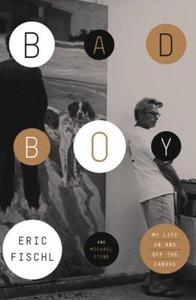
 Eric Fischl's iconic painting Bad Boy is a dim, dreamy scene of 20th-century suburban unease: a voluptuous naked woman luxuriates on a sun-slatted bed, playing with her toes, legs open; she appears oblivious (or indifferent) to the young boy standing at the foot of the bed, his back to the viewer, staring down at her--and reaching one hand into her open purse behind him.
The painting is about "desire, voyeurism, appropriateness, and boundaries," Fischl writes in his memoir, also titled Bad Boy. Like much of his work, Bad Boy explores the taboo, drawing attention to the contradiction between public appearances and private truths. It's an uncomfortably Oedipal scene, one that "equates the boy's moment of sexual discovery to a theft."
Fischl also suggests the painting is in some sense autobiographical, a depiction of the confusion and chaos underneath the shiny, idyllic surface of his suburban youth. The son of a latently creative, "ferociously" alcoholic mother and an ineffectual father, Fischl grew up on Long Island in New York in the 1950s and '60s amid dysfunction and denial. The "numbing disconnect" between his family's public and private lives, so traumatic for Fischl as a child, eventually became the force that drove his creativity. "Each one of my paintings is like a journey, a process to excavate nuggets of emotion, artifacts of memory, the treasures buried in my subconscious," he writes.
Bad Boy chronicles Fischl's maturation into an extraordinarily successful artist, particularly as a narrative painter during a period in which the art world revered formalist abstraction and conceptual art. A part of the wildly innovative, excess-fueled downtown New York scene of the 1980s, Fischl rocketed to art stardom following the 1982 exhibition of Bad Boy--then struggled to stay true to his art as the art world became the art market.
Fischl's memoir is an engrossing account of that heady time, and he writes candidly, without apology, about his own struggles and process. The book gets slightly less interesting as it goes on, however: the stuff of his earlier years (like his experimentation with different media, and his evolving relationship with his wife, painter April Gornik) is more compelling than more recent material about playing tennis and vacationing in St. Barts with his famous friends. Still, Bad Boy is worth a read, even for those uninterested in Fischl's work: his memoir, like his art, tells a good story. --Hannah Calkins
Shelf Talker: Eric Fischl chronicles his evolution from "suburban bad boy" to premier American narrative painter in this candid, insightful memoir.