

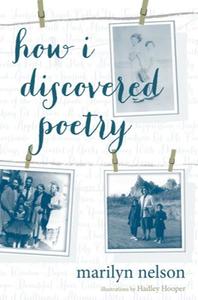
 Marilyn Nelson (A Wreath for Emmett Till) calls this collection of 50 poems "a personal memoir, a 'portrait of the artist as a young American Negro Girl.' " As in James Joyce's A Portrait of the Artist as a Young Man, the protagonist of these poems is a stranger in her own land. She sees its beauty and its cruelty. Nelson harnesses her observations into unrhymed sonnets with iambic pentameter, and unpacks their power one line at a time.
Like Joyce, the poet begins with a seemingly nonsensical riff on "Once upon a time." She writes, "Once upon a time. Upon a time?/ Something got on a time? What is a time?/ When it got on a time, could it get off?" But at the close, she contemplates a danger to her father, mother and sister: "If there was, once upon a time, a fire,/ and I could only rescue one of them,/ would I save him, or her? Or Jennifer?/ Four-year-old saves three people from hot flames!/ God bless Mama, Daddy, and Jennifer."
The poems cover the evolution of a child's thoughts from age 4 to 14, from 1950 to 1959, in states stretching from Ohio to Texas, and California to Maine. They chronicle the becoming of a poet and the maturation of a nation. Nelson's poetry--like that of Frost and Dickinson--moves from the specific to the abstract and back again. On the eve of her best friend, Helene, moving away, Nelson writes, "Tomorrow I'll feel lonely as Sputnik," only to have Helene put their situation in a larger context in the last lines: "Helene talks about the kids in Little Rock:/ how brave they are, how lonely they must feel."
Nelson's voice takes the form of a child trying to make sense of a world that adults have largely botched: "I read while the television talker/ talks about career and the hide drajen bomb./ .../ We ducked and covered underneath our desks,/ hiding from drajen bombs in school today./ Maybe drajens would turn into butter/ if they ran really fast around a tree," she writes in "Bomb Drill," as the six-year-old makes a connection to the tigers from Little Black Sambo transforming to butter. Later, at age 12 (in "Attic Window"), young Marilyn questions the American mythology--the Sweet Land of Liberty and Thanksgiving: "The more time I spend in the library,/ the less sure I am about everything./.../ I read by the window in the attic,/ and things people believe in are unmasked/ like movie stars whose real names are revealed/ in their obituaries."
Yet her family's travels, due to her father's work as a B-52 pilot, also lead them to the vastness of the West, and the Grand Canyon at dawn: "There's more beauty on Earth than I can bear," she writes. Readers watch the seeds planted in the early poems flower by book's end. Like Stephen Dedalus in Joyce's Portrait, a teenage Marilyn begins to own the power of what a calling as a writer might mean. --Jennifer M. Brown
Shelf Talker: Three-time National Book Award Finalist and Newbery Honor author Marilyn Nelson offers a memoir of her 1950s childhood through 50 poems.