

Earlier this month at the Society of Illustrators in New York City, Cecilia Yung, art director and v-p at Penguin Books for Young Readers, welcomed an audience of teachers, librarians and other children's book enthusiasts to a presentation by three of the artists honored in annual exhibit of called "The Original Art." This year, the show honored 125 books. Yung organized the program with Brooklyn Public Library's Judy Zuckerman, and Anelle Miller, director of the Society of Illustrators.
"Picture books allow children to experience artwork even if they're far from major museums," Yung said, adding that it's often their first exposure to art. Jerry Pinkney, Jeanette Winter and Peter Brown provided insight into their creative process.
 |
|
|
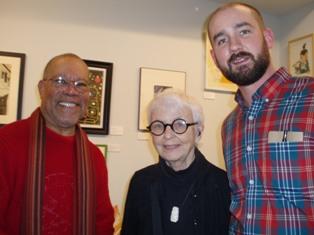
Jerry Pinkney, Jeanette Winter and Peter Brown, three of the artists featured in the "Original Art 2013" exhibit at the Society of Illustrators. |
|
"Most of the work happens on my drawing table," Jerry Pinkney explained. Like his Caldecott Medal–winning The Lion and the Mouse, Pinkney thought his most recent book, The Tortoise and the Hare, would be wordless, but he wanted the process to be organic. As he considered the moral of the story, he thought, "Wouldn't it be interesting if the moral unfolded on the spreads with the tortoise?" He started working out the dummy and, using the moral as a cumulative text, discovered that it corresponded perfectly with the spreads featuring the tortoise. The artist uses marker to draw on vellum, then places the drawing on a light box, and watercolor paper over that. This way, he can keep developing the drawing (in pencil), tracing over the marker, and use watercolors on the final drawing. Pinkney passed around his childhood copy of Aesop's Fables, illustrated by Arthur Rackham, which has inspired several of his most beloved picture books. Other inspiration comes from his personal collection of more than 3000 books on nature and African American culture.
Jeanette Winter also emphasized her materials. As a child, she said, "Nothing made me happier than a new box of Crayolas with their pristine points." She learned to draw with charcoal, pencil, pen-and-ink and Cray-Pas (oil pastels) in high school. She illustrated her first book, The Christmas Visitors, with etchings, then used watercolors for Follow the Drinking Gourd. "My natural way of seeing and thinking is small in scale," she said. Her original art for her most recent book, Henri's Scissors, is smaller than it appears in the book. Winter credits David Hockney with her most recent medium: pictures created on an iPad. She saw work Hockney had done on the iPad and was inspired to try it for herself. Her forthcoming book, Mr. Cornell's Dream Boxes (Beach Lane Books, July 2014) will feature art created using this new tool. "Each drawing can be like an animated film," she explained. "Children were his favorite audience," she said of artist Joseph Cornell, who once held an opening at the Cooper Hewitt for children only, with the boxes all hung at a child's height, and brownies and cherry coke as refreshments.
"As a kid, I wanted to be an old man making art," Peter Brown admitted. His grandfather was an amateur artist, and Brown has a theory that "children don't see artists as grown-ups making art." He struggled in school, yet made his first book at age six. He joined the Philadelphia Museum at 16 and took a foundation studies class. "I was on a quest to find a visual voice for myself," Brown said. When he sees a piece of art that resonates with him, he asks himself, "Why do I love that painting? Is it the color? The composition? The naïveté? The pattern? The use of light and shadow?" He called Babar an inspiration for his latest work, Mr. Tiger Goes Wild. "Babar goes from being naked on four legs to having clothes and standing on two legs with the turn of a page," Brown observed. "I decided to make a book that's the inverse of that." (Mr. Tiger sheds his clothes.) He wanted to strip down images to their essentials (forgive the pun). "How simply can I show a tree and have it read like a tree?" he wondered. He used a similar approach with the transition from Mr. Tiger going from an upright standing position to walking on four legs. Brown draws with black ink or watercolor on paper, then scans the work and uses Photoshop to create hundreds of layers on each picture.
Perhaps Jerry Pinkney summed up the afternoon's discussion best: no matter what the process in the creation of the art, "We bring pieces of ourselves to the work on the wall." The show closed on Saturday, but a selection of 40 works from it will tour colleges throughout the country, a tradition going back nearly 30 years. --Jennifer M. Brown