

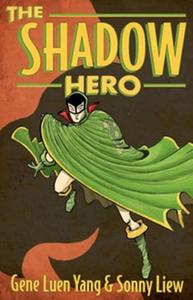
 Gene Luen Yang's latest tour de force begins in 1911, soon after the events of his mesmerizing National Book Award finalist, Boxers & Saints. The Ch'ing Dynasty has just collapsed, imperial rule has ended and China is in chaos.
Artist Sonny Liew (Malinky Robot) connects the historical and mystical realms on the first page, through the adorned red scroll of the chapter header and the matching red backdrop to a panel depicting the council meeting of the dragon, phoenix, tiger and tortoise spirits. Three of them quarrel about the best way to support China, while the tortoise boards a boat for the West, and "[takes] up residence" in the body of a drunken man--the narrator's father.
Yang and Liew imagine an origin story for the Green Turtle, created by Chu Hing during Golden Age of American comics in the 1940s. Yang credits Hing as being among the first Asian Americans working in the U.S. comic book industry.
Liew's washed-out panels mirror the narrator's mother's mood when she arrives in the U.S. She'd been expecting "a land of color and astonishment"; instead, she discovers rude people and streets smelling of "old butter." She becomes betrothed to a "modestly successful grocer," and they have one child, Hank. Hank and his father work together in the grocery; his mother serves as a housekeeper and sometime chauffeur for the Olsons, a wealthy family. When a robber hijacks the Olsons' car as Hank's mother idles at the wheel, she is saved by a superhero ("the Anchor of Justice"), and decides Hank should become one, too. Humor abounds as she tries different approaches (she makes him a costume, pushes him into a chemical spill and arranges for his martial arts lessons). At the same time, Yang exposes the corrupt underbelly of Chinatown's business world.
Yang threads together the plot lines when Hank (as a superhero) attempts to save a woman from some shady characters and, in a comic twist, she winds up saving Hank. Her connection to the underworld brings the Green Turtle face to face with the head of the Chinese mafia. Yang and Liew bring the story back full circle: Hank relies on his natural strength and wits to survive the duel, and the spirits meet again. Through this very human hero and his green turtle alter ego, Yang and Liew debate cowardice versus bravery, vulnerability versus strength, disdain versus compassion. Yang's smart, funny afterword lays out the facts and speculations, and uses Hing's original comics to explain a few of the subtler shadings of the "origin" story (bullet-dodging, ultra-pink skin tones and the shadow itself). The audience will extend beyond comics fans, to those who enjoy noir and good old-fashioned storytelling anchored by historical events. --Jennifer M. Brown
Shelf Talker: The creator of Boxers & Saints imagines an "origin story" for the Green Tortoise, created during the Golden Age of American comics by one of the first Asian-American comics artists.