

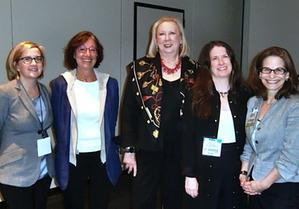
At a panel sponsored by the Women's Media Group, Jane von Mehren, with the Zachary Shuster Harmsworth Agency, moderated a discussion about female career trajectories with four women executives that offered "a fascinating lens on the industry in a time of change."
 |
|
|
L.-r: Libby McGuire, Tina C. Weiner, Jane Friedman, Jane von Mehren and Janet Goldstein |
|
As is often the case when discussing careers, the word mentor came up, and Jane Friedman--who began her career as a Dictaphone typist at Knopf, eventually becoming CEO at HarperCollins and founding Open Road Integrated Media--noted that just that morning one of the greatest mentors in publishing, Oscar Dystel, had passed away. She also credited Tony Schulte, whom she knew at Knopf, with helping her learn to make quick decisions, accept some failure and move on.
"As women we dislike failure," said Friedman, "but if you have any ambition you have to be prepared to make mistakes and go forward."
Janet Goldstein, now executive director of National Geographic Books, spent two decades at Viking and HarperCollins. She acknowledged it might sound like a strange concept, but she suggested women think of their work lives as a brand. "People know the way you approach your work," she said. So when a new opportunity comes up--like publishing Barbara Kingsolver although Goldstein hadn't been a fiction editor before--women's expertise and ownership of their work would prevent them from being "siloed."
Libby McGuire, publisher of Ballantine Bantam Dell, who began her career as a marketing assistant, said she learned a great deal from watching others navigate the work/life equation early on. Even before she worked for Gina Centrello at Random House, McGuire--who had not yet had her family--admired the female executive for going home for dinner every evening.
Tina C. Weiner started her publishing career coding exam copy at Yale, learned the university press's entire catalogue and was eventually hired by the publisher's publicity director, who thought the young woman seemed "eager" to do the work. Now, as director of the Yale Publishing Course, Weiner said she wants people to think of taking the course at mid-career without mixing it up with the notion of mid-life. As one Yale lecturer explained, Weiner said, "you can take control of your career and you don't have to leave." Her best piece of advice for women in publishing is to be flexible.
While Friedman is pleased that women in publishing have called her a mentor, she said, what that really involves is having an open-door policy. "You're the future," she said. "I want to listen and help." Mentoring is a tradition that has proved to be a long one in publishing. "If I want a future in mentoring, I need the mentees," said Friedman. "Ask questions--no question is foolish." With new book formats--and Friedman noted that the book business has had multiple formats for a long time--she thinks "this is the new Golden Age of publishing." --Bridget Kinsella