

 Because so many people at Winter Institute 10 in Asheville, N.C., asked about the Kid and Teen Advisory Board program at BookPeople of Moscow, Moscow, Idaho, store co-manager and children's and gift buyer Jesica Sweedler DeHart put together the following outline of how the program works and how to launch one. She notes that this is a work in progress and would like to hear from others about their successes via e-mail.

|
|
| DeHart | |
1. Contact your children's/YA book reps to let them know you will be launching this program and ask them to send you ARCs/store copies of books they are excited to have reviewed.
2. Send two separate e-mails to prospective parents of teens (ages 12-18) and kids (ages 8-12) inviting them to have their kids submit a book review (3-5 sentences/100 words or less) of a book they have loved in the last year in order to be part of the Kid or Teen Advisory Board. In this letter, lay out how the program will work, including meeting times (my group meets the first Sunday of the month at 2:30 p.m. for kids and 4 p.m. for teens). Ask that participants commit to attending a minimum of five meetings per year (this allows for sports/travel/weather). Each meeting lasts approximately 30-45 minutes and snacks are provided. Kids/Teens are invited to "borrow" four ARCs at a time to write reviews.
3. Ask that all reviews be sent in this format:
- name of the book and release date in e-mail header (no attachments, and only one review per e-mail)
- the body of the e-mail needs to include the title of the book, author, publisher, review and how the teen/child would like their review signed (some want to include their age, school, grade. I always list their first name but never their last name).
- they never have to finish a book they don't like, but they do need to explain in a sentence why they didn't like it. I will post only positive reviews to our Facebook page/website, so I ask that the reviewer make it very clear how they feel about the book. I prefer reviews that tell me what the reader thinks and feels about a book instead of just summarizing. Did it keep them up all night? Was it the best historical fiction they had ever read? Did they miss the school bus because they were reading it? Did it surprise them or make them think about a new issue? Who would this book appeal to?
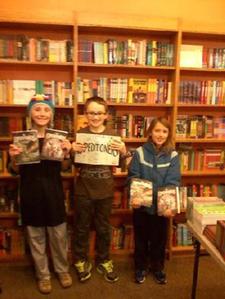 4. Once a month I meet with the Kid and Teen Advisory Boards (separately) and start by highlighting a handful of books that I am either interested in having reviewed or ones that I have read and loved. I give the kids/teens an opportunity to talk about a book they loved, and often that ARC gets handed to the next eager reader. I try to acknowledge kids/teens who have had their reviews noticed by the author. Sometimes I have giveaways, and then I let them sign their returned books and check out a maximum of four new ones. They can swap their books out/in anytime during the month, but they can only have four out at a time.
5. I have created e-mail folders to house all of the reviews that I receive. I try to share as many of the reviews with the publishers as far in advance as I can. Some of my reps love getting them and respond enthusiastically every time. On or right before the day of release (or when I think of it), I post on Facebook about the book and include the kid/teen review with a photo of the book. I make sure to tag the author and publisher in the post. I then leave a note on the author's FB page letting them know that I have just posted a review of their book and invite them to visit our FB page, like us and leave a comment for the teen/kid. I then share these comments with the parent/teen/kid (depending on whose e-mail address I have).
6. Once I have posted a review to FB, I forward the review to our staff member who posts it to our website. I post only well-written and interesting reviews that will sell the book. Sometimes I give helpful writing technique feedback either via e-mail or when we meet as a group, and read examples of great, usable reviews. My kids/teens are getting really good at writing creative and eye-catching reviews.
7. Every month I go through my ARCs and decide which ones I want to keep in circulation for further reviews. (Some books are so popular that they stay in circulation and continue to bring in reviews long after the book has been released. I often do multiple FB posts on a single title over several months.) I box up all of the books that we are done with and donate them to our local schools to be used in the classroom or to be given away to Title 1 students in need of books at home. I ask that teachers write "donated by BookPeople" on the cover of each book as free advertising.
8. For the most part, I do not give the books to the Kid and Teen Advisory Board members, which means they often want to buy their favorite books. On the days of our meetings, their families receive a 20% discount so they stock up on books at that time. On occasion--or if a kid/teen really begs--I will give away books from the discard pile once the release date has passed. I like to do drawings for good attendance or for those that have gotten their reviews to me before our meetings. I also do book giveaways during the summer when they might need more incentive to attend a meeting.
9. I have a simple sign in/out sheet for the kids/teens that we have tweaked throughout the year. (If any of you design one you love, please send me a copy.) Each kid/teen has their own sheet, with space for several months of signing books in and out. We keep all the sheets in a folder behind the counter and the books on a designated bookshelf tucked into a corner, organized by release date and YA/children's. I keep the F&G picture books with the children's. Teens are welcome to review books for the kids' section and the more mature kids can review YA books, as long as they are making their group's reviews the priority. I always let kids know, in front of their parents, that YA books often contain sex, drugs, violence and content that might be too mature for them or make them uncomfortable, and that they should have their parent look through the book first.
10. Hand selecting the kids/teens is important. We choose people we know, teachers/professors with kids, customers we have gotten to know, and the local school librarians gives us names of GT kids. The programs have have resulted in our store being noticed by authors, illustrators, our reps and publishers, and the community has been incredible grateful.