

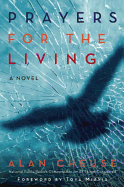
 The new publishing house Fig Tree Books, whose stated mission is to "chronicle and enlighten the unique American Jewish Experience," has revised and reissued NPR critic Alan Cheuse's 1986 novel The Grandmothers' Club as Prayers for the Living. If this morally complex saga of one man's rise and spectacular fall in late 20th century America is typical of the quality of the publisher's titles, its future is promising.
Minnie Bloch, who provides the novel's voice, isn't the typical narrator, and her son, Manny Bloch, isn't the typical Reform rabbi. Immigrants to the Lower East Side in the 1930s, their lives are upended by a tragedy that propels Manny into the rabbinate and simultaneously connects him with the woman who will become his wife. Through her family he becomes involved in a business career that for a time he pursues alongside his religious duties, but that ultimately seduces this man who had a "calling for one kind of life and a yen for another kind of life" to become someone "slipping out of one life like a snake from its skin and taking on another."
Cheuse's novel is based on the story of Eli Black, a rabbi turned businessman who became enmeshed in scandal in the 1970s, when he was accused of bribing Honduran government officials to benefit his business, United Brands. But Cheuse (A Trance After Breakfast and Other Passages) is less interested in the precise details of that story, or the intricacies of Manny's business machinations, than he is in considering how idealism and integrity can give way under the pressure of pursuing outsized financial rewards.
Though this wouldn't be a Jewish mother's narrative without the occasional "oi," one of Cheuse's signal achievements is his avoidance of caricature in the way he captures Minnie's distinctive voice--a blend of pride, worry and ultimately deep sorrow--as she chronicles the unraveling of her beloved son's world. In spooling out this tale to an audience that includes, at various points, her friends and fellow bubbies, along with her son's mistress (a Holocaust survivor), she's keenly attuned to the toll the drive for success inflicts not only on Manny but on his troubled wife and rebellious daughter. She's a capable storyteller, effectively employing foreshadowing and even a dash of magical realism that evokes the work of Bernard Malamud.
While all of its principal characters are contemporary American Jews, Prayers for the Living possesses the feel of a Greek tragedy. Readers share Minnie's apprehension as the story marches toward its seemingly preordained conclusion, hoping for a different ending while knowing one is impossible. --Harvey Freedenberg, attorney and freelance reviewer
Shelf Talker: This revised version of Alan Cheuse's 1986 novel The Grandmothers' Club is the powerful saga of a rabbi turned businessman's rise and spectacular fall.