

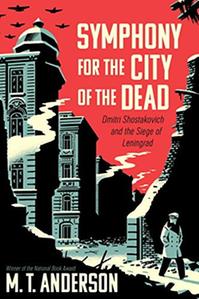
Symphony for the City of the Dead: Dmitri Shostakovich and the Siege of Leningrad (Candlewick, September 22, 2015) is the first work of nonfiction for teens from National Book Award winner M.T. Anderson (The Astonishing Life of Octavian Nothing). Combining history, biography and musicology, Anderson introduces composer Dmitri Shostakovich, whose life and work were intimately entwined with the history of Russia from the Revolution to the Cold War. Here he describes the seeds for the project.
What inspired you to choose a topic that approaches history from a musical point of view?
I'm always interested in how deeply the arts affect our lives. Our culture tends to think of the arts as superfluous, a luxury--but in this case, a symphony changed the lives of thousands.
Were you at all daunted by the thought of writing about classical music for young adult readers? How did you approach describing how a symphony sounds to a reader who may never have listened to one?
Dmitri Shostakovich's music is very vivid and dramatic, which makes things easier. What I tried to do was describe what the original audiences heard and how they understood this music--an intriguing question in itself, given how much debate there is about the images in the symphonies and their secret messages, their codes.
 In what ways did you shape the narrative for the young adult audience?
If I had written the book for adults, I probably wouldn't have described Shostakovich's childhood or those harrowing, triumphant teenage years following the Russian Revolution. But I felt it was important for young readers to get a glimpse of him as a child--and then to see what he was capable of, even when he was in his teenage years. His first symphony, written when he was a 18, made him world famous. That's an incredible testimony to what kids can do when they have passion and focus. I hope his example inspires them.
When I pictured my audience, I pictured young musicians, actors and artists. I wanted to show them what's possible, and why their work is so important to the rest of us.
In some of the narrative's most compelling moments you step back and ask readers to be critical about the legitimacy of a story you've just shared about Shostakovich's life. These moments draw readers even further into the narrative, rather than coming off as didactic. How did you set that up?
Well, all of history is just a story we tell ourselves--but this is particularly important to remember when you're talking about a totalitarian regime, where facts are constantly being erased, changed and revised. Stalin infamously ordered many photographs doctored to remove his enemies from the past. It wasn't enough to purge them from the present.
Though dictatorships provide a particularly stark picture of how the historical record is revised, I want to inspire kids to join in questioning our own historiography, too. The powerful in any society always write history and revise both the past and the present. Consumer capitalism is not generally as brutal in its methods of concealing facts or obliterating truth (about, say, industrial exploitation or global climate change)--but the effects of its evasions are just as wide-reaching and occasionally even violent.
Seeking out the truth is one of the most dramatic and heroic things kids can do right now or in any age. I would love to provoke them to take up that battle. --Angela Carstensen, school librarian