

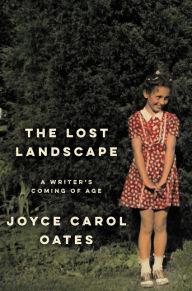
 Prolific author Joyce Carol Oates (Lovely, Dark, Deep: Stories; A Widow's Story) chronicles her formative years in The Lost Landscape, a book that Oates states is "not meant to be a complete memoir of my life--not even my life as a writer," but rather "something more precious... an accounting of the ways in which my life (as a writer, but not solely as a writer) was shaped in early childhood, adolescence, and a little beyond." Oates, insightful and reflective, examines influential people, places and events that took root in her psyche beginning with her childhood in western New York State, a rural landscape north of Buffalo.
The book offers 28 essays previously published in literary journals over the course of decades. Oates, the quintessential observer, stitches together memories through a prism of age and experience. She is most enthralled by the mystery of the familiar, her place in it and how that "familiar" is often taken for granted until it is "finally taken from us."
With that in mind, Oates yearns to understand her "young, attractive and mysterious parents," who were physically close to her yet stoic in their approach to life, and therefore "inaccessible and unknowable." Oates believes that in order to understand better her parents, relatives and other "strangers" who once populated her world, she must write their stories. Thus, she begins by mining the lives of her mother and father--their upbringings and personalities, sacrifices and losses, passions and devotions. She digs into the nature of family secrets, namely how two rarely spoken of violent acts in the respective histories of each parent significantly fertilized Oates's natural curiosity and imagination.
In these accounts and others, Oates reimagines the past and offers well-wrought remembrances of pivotal, defining moments, including a cleverly rendered piece narrated by Oates's beloved pet hen from childhood. Other stories expound on Oates's early experiences with death; how Alice in Wonderland changed her life; her autistic sister; a friend's suicide and another who was sexually abused; and a serial murder case that inspired one of her most notable stories, "Where Are You Going? Where Have You Been?" Each essay reveals more about Oates's character and her vulnerabilities, including bouts of childhood shyness, anxiety and insomnia, as she winds her way through college and graduate school, where she, disillusioned, felt like an outsider. The book poignantly closes with tributes to both of her parents and how, even in absentia, they continue to resonate in the author's life--creatively and otherwise.
Oates believes that a "writer is the decipherer of clues," and in this sensitive, illuminating exploration of her early years, she offers fascinating glimpses of the ways in which reality has often served to inspire the fictitious worlds and characters she has created in her wealth of novels and stories. --Kathleen Gerard, blogger at Reading Between the Lines
Shelf Talker: Joyce Carol Oates intimately examines the ways in which her formative years--and the people therein--influenced her life.