

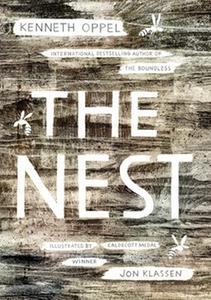
 "Nest" is supposed to be a cozy sort of word. It's where animals feel safe enough and comfortable enough to sleep. But nests are not cozy places in The Nest, a chilling nailbiter from Printz Honor author Kenneth Oppel (Airborn), and Steven is having a hard time sleeping in his.
Steven is an anxious boy. He worries about everything, most of all his sickly baby brother, Theo, who has a congenital disease no one can quite figure out. His little sister is endlessly optimistic about the baby's future: " 'And then he'll be all better?' asked Nicole, running her truck back and forth over an action figure." But his parents are a wreck. Meanwhile, Steven is having dreams. At first, he thinks he's being visited in his sleep by gossamer-winged angels, haloed by light. But these angels are no angels. They materialize to Steven as silvery, human-sized wasps: they've decided to replace the sickly Theo with a healthy baby, and they need Steven's help to do it.
Steven goes to a psychiatrist who tells him dreams aren't real, but the wasp queen in his dream proves she is by biting him on the hand... and two small dots are still there in the morning. Things get downright David Lynchian when the gaunt, pincer-handed knife-sharpener guy bangs on Steven's front door when he's the only one home, and leaves a long, curved blade on the doormat. If that isn't quite creepy enough, his little sister's toy telephone actually rings, and the "shrill and raspy" voice of Mr. Nobody is on the other end. But the worst moment of all is when Steven says "Yes" to the wasp queen, not knowing exactly what he's agreeing to do. She replies, '' 'Yes' is a very powerful word. It's like opening a door. It's like fanning a flame. It's the most powerful word in the world." Steven knows he's done the wrong thing, and he feels sick about it.
The wasps offer up the perfect human baby to his family, but Steven realizes that perfection isn't real, not even desirable. Could the wasps "fix" him, too, then? Make him less compulsive and fearful? If they did that, would he still be himself? What would be the cost? The wasps pull Steven into a world that goes even deeper than DNA, burrowing into human existence on a mitochondria-level, like Madeleine L'Engle's A Wrinkle in Time did so many decades ago. Manufacturing "perfection" starts to look sinister indeed, and readers are challenged to examine questions about what "normal" is, and, indirectly, the ethics of genetic engineering, all in the guise of a fantastical thriller.
Caldecott artist Jon Klassen's (This Is Not My Hat, Sam & Dave Dig a Hole) moody graphite illustrations help build the sense of horror, capturing quiet scenes from the eye of an unseen observer: Mom and Dad in a shadowy back corner; standing over Theo's crib; an aerial view of the curved blade on the doormat. Wasps hover over chapter openers in disturbingly increasing numbers as Steven's internal struggle escalates to a full-on, real-life battle for survival. As he says, "It was a bad summer for wasps. Everyone said so." --Karin Snelson, children's editor, Shelf Awareness
Shelf Talker: In Kenneth Oppel's haunting novel, a boy grapples with nightmarish wasps who offer to replace his sickly baby brother with a healthy one.