

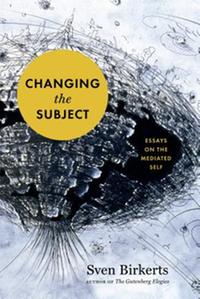
 When it comes to the debate over the digital world's effect on our habits of thought and our engagement with the written word, AGNI editor Sven Birkerts is no newcomer to the conversation. In 1994's The Gutenberg Elegies, he identified a cluster of unsettling trends that have only intensified since that time. Changing the Subject: Art and Attention in the Internet Age can be viewed as a companion work, one that's no more sanguine than its predecessor about the survival of traditional reading culture.
Though he acknowledges the argument of writers like Nicholas Carr, in The Shallows, that electronic media literally are rewiring the neural pathways of our brains, Birkerts is more concerned with broader social trends, ones that he returns to repeatedly, but not repetitiously, in this collection. Citing the "preference algorithms and instant data search" of sites like Wikipedia and Pandora, he laments the "movement away from the notion of the individuated 'I' and toward a more networked, which is to say collectivized, existence." The ever-present distraction offered by our devices, in his view, competes with the "summoning of attention" that is the essence of art, and more specifically, deep reading.
Whether or not one inclines toward Birkerts's worldview, he shares with the best essayists a talent for leading readers on an intellectual journey, teasing out his thoughts before our eyes. His prose is elegant and almost infinitely quotable, as when, for example, he describes the "sterilized vacuousness we are wrapping around ourselves" in an essay on the Jeopardy competition that pitted Ken Jennings and another all-time champion against IBM's Watson computer program. And his passion for serious reading, manifest in essays on Seamus Heaney and Roberto Bolaño, among others, creates an almost irresistible urge to reach for their work.
The 17 essays that compose this book aren't as personal in tone as those in his outstanding 2011 collection, The Other Walk, but glimpses of Birkerts's personality emerge nonetheless. Though he clearly inhabits the online world, he's proud of the fact that he's never owned a cellphone, while frankly acknowledging the problems that's created for his relationships with family and friends. He gets along less well with GPS devices than his 88-year-old father, who's had a cozy relationship with Siri for some time. But Sven Birkerts is no "cranky Luddite," in the words of one essay's title. Rather, he's a wise and humane guide, offering a gentle restraining hand as we hurtle into the electronic future. --Harvey Freedenberg, attorney and freelance reviewer
Shelf Talker: In 17 essays, Sven Birkerts's thoughtfully explores the tension between the distraction of our omnipresent electronic media and the attention that allows deep engagement with art.