

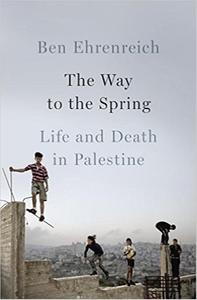
 Ben Ehrenreich's The Way to the Spring: Life and Death in Palestine is a work of nonfiction journalism written with the lyrical passion of a novelist. His two previous books were novels--Ether and The Suitors; for his first nonfiction book, Ehrenreich spent three years embedded with Palestinian families living in the West Bank. In the introduction, he writes: "I do not aspire in these pages to objectivity. I don't believe it to be a virtue, or even a possibility. " He aspires, instead, to "something more modest than objectivity, which is truth." The Way to the Spring is unapologetically on the side of the Palestinian people, marshalling facts, history, anecdote and personal experience in order to persuade the reader to the author's point of view. That does not mean, however, that Ehrenreich's book is interested only in proving rhetorical points. Instead, The Way to the Spring functions primarily as an extraordinary love letter to a people that, through everything, persist.
Ehrenreich has a good eye for the absurdities that emerge under occupation; he catalogues them in interludes under the title of "Occupation Cabinet of Curiosities." In one "exhibit," he depicts a Palestinian house in the town of Mas'ha that was in the path of a wall being built between Israeli and Palestinian sectors. The owner refused to move, and Israeli authorities responded by building both the wall and fencing that left the family "caged in and cut off from the rest of the village." Ehrenreich also writes about the absurdities brought about by the massive inequality that afflicts Palestine. A few top members of Palestinian society have managed to profit off of the occupation, giving rise to luxurious high-rise apartment complexes where apartments would sell for "between $75,000 and $140,000, which sounds reasonable until you remember that the average wage in the West Bank was just over $25 a day."
The heart of The Way to the Spring, as in a novel, is in the characters it introduces. Bassem Tamimi lives in a tiny village called Nabi Saleh. Every Friday, he helps organize and lead a march to the contested spring of the title. Every Friday, Israeli soldiers stop the march with an onslaught of rubber bullets and tear gas. His wife, Nariman, is just as brave, and so is Mariam, a young woman caught up in the Kafka-esque hell of the judicial system. We meet a few settlers, zealots like Baruch Marzel, who describes his community's relationship with its Palestinian neighbors as "Corrective. When someone wants to kill, we'll kill him first."
We get only a peek into the settlers' worldview, however, because Ehrenreich's goal is not objectivity and he doesn't attempt to give anything like equal time. Instead, he analyzes the current situation as seen through Palestinian eyes: the complicated history that lead to the current moment, the hidden mechanisms of subjugation and the vast reserves of hope and bravery that insure the Palestinian people will continue marching to the spring. --Hank Stephenson, bookseller, Flyleaf Books
Shelf Talker: The Way to the Spring is a work of embedded reporting on par with Katharine Boo's Behind the Beautiful Forevers, documenting Palestinian suffering and resistance in the occupied West Bank.