

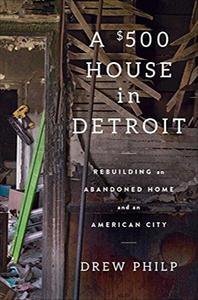
 Whether it's crime, corruption or urban decay, Detroit's seemingly insurmountable array of problems have been well documented. That's why freelance journalist Drew Philp's A $500 House in Detroit is such a tonic. The story of its author's five-year effort to rehabilitate a dwelling in one of the city's blighted neighborhoods is an inspiring portrait of one man's dogged persistence. It offers a clear-eyed glimpse at how a brighter future for the once proud Motor City might be slowly emerging.
A graduate of the University of Michigan, the idealistic Philp, who is white, is the quintessential Angry Young Man. He moves to Detroit--whose population is more than 80% African-American--with "no job, no friends, and no money," trying to reconcile his background of educational privilege with the poverty that surrounds him.
At a tax sale in October 2009, Philp acquires a 1903 Queen Anne house in Detroit's Poletown neighborhood--home to the General Motors Detroit-Hamtramck Assembly Plant that displaced 4,000 residents in the early 1980s while producing only half its promised jobs--and sets to work transforming it into habitable space, to prove "that this American vision of torment could be built back into a home."
With the help of his father, grandfather and a shifting cast of neighbors, Philp slowly acquires the skills that enable him to resurrect this "white-and-gray clapboard shell on a crumbling brick foundation, filled with junk." Along the way, he stands guard over his house on a terrifying Devil's Night, the "annual orgy of arson and destruction on Halloween weekend," and later comes close to dispatching a would-be intruder with a shotgun blast. But in the midst of this nightmare landscape, Philp is quick to spot signs of rejuvenation, whether it's a thriving hayfield or spirited block parties that promote neighborhood solidarity.
Philp layers the account of his backbreaking labor with economic and sociological insights into Detroit's plight, while describing the efforts of other determined homesteaders to reclaim abandoned neighborhoods. He has little patience for the gentrification movement led by wealthy business leaders like Quicken Loans' Dan Gilbert and others he blames for the decline of Detroit's population from 2 million to 800,000, and the loss of 90% of its manufacturing jobs since the 1960s. Instead, he puts his faith in the unceasing toil of his fellow urban pioneers. "We were going to have to pit our humanity against their money," he writes, "and the fate of Detroit was now a microcosm for what was happening to the country at large." It will take time and luck, but if others are as committed as Drew Philp, it's probably not a good idea to bet against this once great city's revival. --Harvey Freedenberg, attorney and freelance reviewer
Shelf Talker: Journalist Drew Philp's memoir is the inspiring story of his personal part in the struggle to revitalize Detroit.