


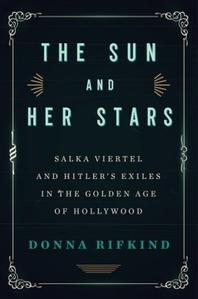
 "If Salka is remembered today, it's not for her screenwriting career or her role in the antifascist emigration; it's most often for her alleged lesbian relationship with Garbo," tuts Donna Rifkind in The Sun and Her Stars: Salka Viertel and Hitler's Exiles in the Golden Age of Hollywood. While she always denied rumors of an affair with her friend the screen legend Greta Garbo, Viertel did have a long extramarital liaison--just one aspect of a multifaceted, heroic and outrageously neglected life to which Rifkind does munificent justice.
A Jew raised in Galicia, Salka Viertel (1889-1978) had been a working actress for two decades when Hollywood came calling--for her Viennese theater director husband, Berthold. In 1928, the couple left Berlin for the U.S., joining a throng of European artists enticed by the promise of film work in California. A few years later, these artists wouldn't just be seeking employment in Hollywood: they would be fleeing Hitler.
In 1932, Viertel began working as a screenwriter for Metro-Goldwyn-Mayer, where her chief task was finding vehicles for Garbo. On Sundays, she hosted salons at her house in Santa Monica. Anyone in her circle of émigré artist friends--Charlie Chaplin, Christopher Isherwood, Thomas Mann--might drop by for chocolate cake and conversation about the latest worrisome news from abroad.
Viertel wasn't content to just talk about the Nazi scourge. She procured the affidavits necessary for artists and others trying to flee persecution in Europe. She convinced her rich and famous friends to sponsor refugees, whom Viertel called her "protégés," and she donated money to the cause. Becoming a U.S. citizen in 1939 emboldened her to do more. She took refugees into her home, tried to find them jobs and helped them to assimilate into the new world, as she had. As Viertel would later write to the actor John Houseman, her house was "the 'port of entry' for so many stranded souls." And the FBI knew it. Suspecting the Viertels of Communism, the government opened files on them, tapped their phones and read their mail.
Rifkind proves with The Sun and Her Stars--her first book and the first English-language biography of Viertel--that she's a superlative chronicler of Old Hollywood. Rifkind also demonstrates, through her accounts of various émigré artists' harrowing escapes from the Nazis, that she's a formidable storyteller. The exhaustively researched The Sun and Her Stars, which relies in part on Viertel's memoir, among other plum sources, includes nearly 30 black-and-white photos, some of Viertel's esteemed émigré friends. "Without immigrants, there would be no Golden Age of Hollywood," writes Rifkind. And without Salka Viertel, Old Hollywood's lights would have shone less brightly. --Nell Beram, author and freelance writer
Shelf Talker: This tour de force of a biography tells the story of an overlooked hero who helped make Hollywood's golden age gleam.