

 Canadians had more free time in 2020, according to a survey of leisure time and reading habits released this week by BookNet Canada. As might be expected during a year when so many people were forced to stay home for extended periods, there was a 10% increase among those who said they had more than enough leisure time from 2019 to 2020.
Unfortunately, time spent reading didn't quite measure up, staying relatively flat. While 53% of Canadians read a book at least on a weekly basis, book and magazine reading did not have any significant increase compared to 2019, the survey noted.
I was not shocked by that statistic, nor by the finding that the activity showing the greatest change from 2019 to 2020 was video gaming--an 8% increase in Canadians who played weekly and 9% increase in those who played daily.
Earlier in the year, Nielsen company SuperData's 2020 year in review had found that 55% of Americans "picked up video games--out of boredom, to escape the real world, to socialize--during the first phase of lockdowns.... As physical spaces disappeared, video games became one of the few places for people to spend time together." And this guy even created souvenir postcards of his video game travels.
 The BookNet Canada survey asked 1,253 Canadians if they had read or listened to a book at least a few times during the past year and 80% said they had, with 13% more respondents reading nonfiction in 2020 compared to 2019. The percentage of readers who had read children’s and YA books almost doubled across formats, despite few changes to the number of respondents who were living with young children between 2019 and 2020.
I love book stats, but I also found myself thinking about words. Specifically, I couldn't get the term margin of error out of my head. "There is a margin of error of +/-3%," pollsters will say when releasing otherwise declarative statistical breakdowns. I guess it sounds more data-driven than words like about or approximately or ballpark number.
On the other hand, Fast Company reported this week that the "vast majority of studies on media use depend on participants’ self-reporting their screen time. The intentions here are good: Researchers want to study people’s normal day-to-day screen habits, rather than carefully dolled-out screen minutes in a lab. Efforts to log usage are complicated by the fact that just because a screen is on does not mean someone is using it.
"Now researchers on three continents collaborated for a new meta-analysis in Nature Human Behaviour, revisiting 12,000 studies. They found 47 studies in which 50,000 people had their screen time logged or tracked in addition to self-reporting it. The results: Just 5% of the self reports were accurate."
So, what is a margin of error? English majors worldwide want to know, though I hesitate to even go there in these times of medieval-like superstition regarding facts. But all the numbers I was digesting yesterday led me to think about margins for error, a different concept that covers the range of uncertainty or options available in planning a future action.
Specifically, I thought about how indie booksellers, in the wake of the CDC's surprise face mask guidelines update last Thursday, were forced to instantly recalculate their margin for error and address the issue as the weekend loomed. We've been sharing some of the empathetic, creative and frank messaging booksellers used to communicate their policies and concerns with customers. Such adjustments on the fly had to take into account not only patrons' reactions to any changes to in-store face mask rules, but the literally death-defying margin for error reflected in those changes.
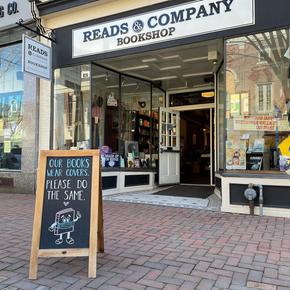 The CDC's statement came as "a complete shock" to Jason Hafer, owner of Reads & Company in Phoenixville, Pa. He told Forbes magazine there had been "a lot of confusion" regarding differing CDC, state and local rules, "with zero time to come up with a true plan." Noting that his unvaccinated seven-year-old daughter has congenital heart disease, he said, "Being the parent of a medically fragile child has been very difficult through all of this, and I feel like we have created a safe environment at the bookshop but need to stick with that not only for my daughter but for our customers and our community."
Reads & Company is currently asking customers and staff to wear face masks and practice social distancing. "The biggest thing we have seen is people assuming they wouldn't need a mask, but then either asking or seeing the sign by the doorway and masking up with no real issue," Hafer added. "There have been a handful of times where people have been resistant, but we feel really fortunate that the vast majority have been on board with us.... It isn't fair or right for our booksellers to be forced to be mask police or vaccine bouncers."
As the Book Lady Bookstore, Savannah, Ga., so eloquently summed up the ongoing Covid-19 margin for error numbers game: "Because CDC guidelines & Chatham County/GA covid & vaccination rates are evolving, so are our restrictions. But it's not a free-for-all, folks."