

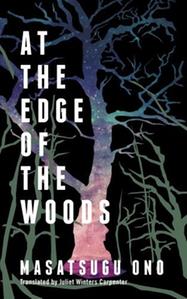
 At the Edge of the Woods is a haunting fable about the disturbing strangeness of modern life. Masatsugu Ono (Echo on the Bay) avoids names and specifics, which adds to the novel's amorphous unpredictability. The novel, translated from Japanese by Juliet Winters Carpenter, follows a family of three: a father and son in their house at the edge of the woods, the mother embarking on a trip to give birth to her second child. They are each plagued by incomprehensible circumstances and a vague, ever-present sense of looming destruction.
Ono freely mixes fantastical elements into the story. The titular woods are reminiscent of dark fairy tales, supposedly containing imps and a "castle" that once served as the headquarters for an unspecified Resistance. The woods are made unnervingly animate at every turn, as when Ono writes: "the trees on either side, dense with foliage, gave the impression they were falling toward us, one after another. It was the same everywhere, and just the sight of the trees made me queasy." Or when the father complains of an insistent coughing coming from the woods. The grim, almost vengeful atmosphere generated by the woods, combined with the sight of floods and refugees on television, suggests that the novel might operate as an allegory for climate change or other ecological crises. At the Edge of the Woods is too mysterious to be fully pinned down, however.
The novel takes on an episodic feel, created by various characters who wander in and out of the narrative, such as a partially naked old woman whom the boy returns home with, claiming that she is his grandmother. Like many of the characters, the old woman carries dark memories of a time of war and occupation, which she shares before disappearing without warning. The novel also has an odd sense of humor, often presenting an acerbic angle on everyday life. In one passage, Ono compares a shopping center to a castle: "To go shopping at a place so high up, you really had to have a car. What were people who couldn't drive supposed to do? Vassals unable to drive need not apply, eh?" The book's most lasting impression might be the anxious mood that pervades the novel, the sense of the world--including other people--as irrational, unknowable and threatening. Some readers might think At the Edge of the Woods has perfectly captured the mood of the times. --Hank Stephenson, the Sun magazine, manuscript reader
Shelf Talker: In an eerie, fable-like novel, a family lives beside a forest filled with mysteries and an indefinable, threatening aura.