

 |
|
| (via) | |
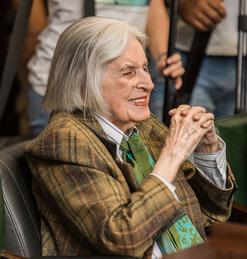
Lygia Fagundes Telles, "one of Brazil's most popular writers, whose stories of women trapped in unsatisfying relationships could also be read as allegories of her country's political situation," died April 3, the New York Times reported. She was 98. Despite her literary success, she continued working as a lawyer in civil service for much of her career.
In a 1980 memoir, The Discipline of Love, Telles recalled that an early critic found her stories suffered only from lacking a "bearded author." She wrote: "I was super happy: To write a text that deserved to come from the pen of a man, that was the greatest thing for a girl in a bonnet in 1944. I worked, I studied and I chose two vocations that were clearly masculine: I was an unconscious feminist but I was a feminist."
Her best known novel, The Girl in the Photograph (1973), "tells the story of three starkly different young women during the regime's most repressive years and includes graphic descriptions of officially-sanctioned torture, a subject that seemed certain to get the work banned by military censors. But in a twist of fate, the censor apparently found the book so boring that he gave up reading before he got to that part," the Times wrote.
She self-published her first book of short stories, Cellar and Townhouse, in 1938 at age 15. Her second collection, Living Beach, found a publisher in 1944, a year before she earned her law degree. For several years, Telles wrote a weekly column in A Manhã, a Rio newspaper, before publishing The Marble Dance (1954), "her first collection to deal frankly with female sexuality. It was this book that Ms. Telles felt marked her arrival as a writer and led her to disavow her earlier works," the Times wrote. Her other books include Summer in the Aquariu (1963), Before the Green Ball (1970) and The Garden Gnome (1995).
Telles earned several literary honors. In 1985, she became the third woman elected to a seat in the Brazilian Academy of Letters. She won the Camões Prize, sponsored by the governments of Portugal and Brazil, in 2005 and was nominated for a Nobel Prize in Literature in 2016 by the Brazilian Writers' Union.