

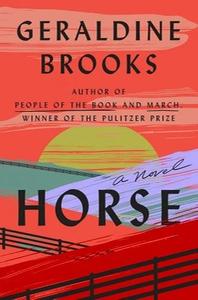
 For her sixth novel, Geraldine Brooks (Caleb's Crossing), who won a Pulitzer Prize for her novel March, here crafts the biography of a seminal horse in the guise of a marvelous novel. Brooks structures the book like a mystery, moving among key characters in the shaping of the horse's life in the pre-Civil War South, and those who bring the significance of a long-forgotten horse skeleton to light nearly two centuries later.
The book opens with the discovery of a discarded painting of a horse. Theo is a Black doctoral student at Georgetown studying art history in 2019; a polo star in his boarding school days, he developed a love of horses and seeks to learn more about this painting he found in a neighbor's trash. Jess, an Australian managing the Smithsonian's vertebrate Osteology Prep Lab, meets Theo at the bike rack outside the Museum of Natural History when she implies that Theo might have mistaken her bike for his. Their chance encounter blossoms into a relationship, fraught with misunderstanding on Jess's part of what Theo's experience as a Black man living in Washington, D.C., and moving through a world dominated by whites might be like. But they form a connection based on their mutual interest in this horse, his for its history, represented through art, and hers for the scientific puzzle the horse presents.
The most moving and compelling relationship of the novel, however, is that between the horse, named Darley and later knighted Lexington, and Jarret, the enslaved boy--and later man--who trained and cared for the horse from its foaling to stud sire to his retirement to pasture. Other characters with various connections to the horse each bring layers of complexity to the stallion's storied place in equestrian history, but Brooks's strongest chapters follow the movements of Lexington and Jarret, as they pass together from owner to owner. Jarret's integrity shines through, despite chapter headings that telegraph the household to which he belongs (e.g., "Ten Broeck's Jarret"), until he shows up a free man in 1875 New York (in the chapter "Jarret Lewis"). Through Jarret's story, the author reveals the unique and indispensable role Black trainers and jockeys played in the pre-Civil War South. Brooks's copious notes at the back inform readers of the facts, and where she used her imagination to fill in the gaps.
Equestrian or no, readers will appreciate Brooks's invitation to linger awhile among beautiful and graceful horses, to see the devotion they engendered in her characters and in the author (a horsewoman) herself. --Jennifer M. Brown
Shelf Talker: Pulitzer Prize-winning author Geraldine Brooks crafts the biography of a seminal horse in the guise of a marvelous novel.