

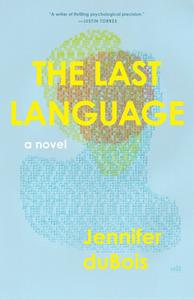
 The Last Language by Jennifer duBois (A Partial History of Lost Causes; Cartwheel; The Spectators) is an utterly compelling puzzle of linguistics, perspective, and some version of love. Angela is 27 years old when her husband dies suddenly; she is four months pregnant (a pregnancy she will lose, "because of the stress, possibly") and has a four-year-old daughter. Just months later, she is kicked out of her Ph.D. program in linguistics at Harvard, following a nasty exchange with her "intellectual rival and personal archnemesis." With her daughter, Angela moves in with her mother and takes a low-paying job running an experimental therapy for "facilitated communication" to help nonspeaking patients with motor impairments. This questionable opportunity will have profound consequences. Readers gradually become aware that Angela is writing her first-person narrative while incarcerated. She tells of her love affair with a young man who can communicate only through Angela herself. Or, if readers do not believe her account, she has taken egregious advantage of a seriously disabled man.
Angela's background in linguistics gives her a complex, many-layered perspective on Sam O'Keefe's ability to communicate and even to think: "if thinking was language, the linguistic determinist would argue, then there was nothing to discover within people who didn't have it already." Despite early reservations, she is quickly taken with Sam's sardonic humor, the life behind his startling eyes, his wit and intelligence--at least according to her account. Angela is very smart and has a thoroughly expert grasp of languages and linguistic theory; she knows what this looks like, but she knows her love for Sam, and his for her, is real. Readers must decide for themselves. This question is at the deeply intriguing heart of The Last Language. Is Angela a deluded predator or among the most misunderstood lovers of all time? DuBois's choice to give readers only her perspective on this story is critical to the contortions of this gripping psychological drama.
Angela is ardent. She makes poor decisions, but her love is pure. She sprinkles her narrative with linguistic trivia and philosophic musings: she anticipates the arguments of the prosecution in her case and those of the linguistic scholars who would say "a person cannot conceive of what he cannot name." She writes to Sam, who will never read her account: "In a very real sense, there was no you." Together, she and Sam read Nabokov: Pale Fire rather than Lolita, but the parallels present themselves. Backed by Angela's academic scholarship and the philosophy of what constitutes humanity, The Last Language is a smart intellectual riddle and a mystery with the highest of stakes. Readers will find it unforgettable. --Julia Kastner, librarian and blogger at pagesofjulia
Shelf Talker: A Harvard-trained linguist enters into an intimate relationship with a nonverbal man in this riveting riddle of a novel.