

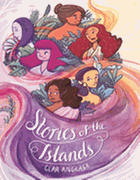
 Clar Angkasa makes her debut as an author and artist with the exhilarating Stories of the Islands, in which she subverts three traditional folktales from her native Indonesia, beautifully, boldly demanding agency for women and girls. Her vibrant, inviting panels and spreads appear with and without borders, as if subtly reminding readers that borders are fluid and often unnecessary.
The opening tale, "Keong Mas," introduces a "Fish Lady" doing her work and returning home. The text, however, initially belongs to the silent thoughts of a snail revealed to be a princess trapped in the shell. The Fish Lady's patient kindness to the snail engenders genuine freedom and meaningful companionship. In "Bawang Merah Bawang Putih," a blended family of four is grateful "they already had their happily ever after," particularly the two daughters, Merah and Putih, who become sisters. But their joy is usurped by Mother's death, which turns Father unrecognizably cruel. As the girls mature, they must make their own choices. Old Mbok Srini (deemed "old" only because she's unmarried) is commanded to plant a magic seed by a vicious giant who promises to return for the "fruit of my choosing" in "Timun Mas." Her fertile garden yields a daughter Mbok Srini never knew she even wanted, who turns out to be her own clever savior.
In illustrating her feminist versions, Angkasa, who was born and raised in Jakarta and now lives in Brooklyn, also pays visual homage to her Javanese cultural history by garbing her characters in sarongs and selendangs (a shoulder cloth); highlighting splendid fabrics of "any color, pattern, and texture imaginable" spun on a traditional loom, and capturing iconic village landscapes of lush tropical greenery, thatched-roof huts and markets, and terraced rice fields. Angkasa's vividly saturated images use enhancing color palettes matched to each individual story to build tone and setting: she presents "Keong Mas" predominantly in royal purples and golds; "Bawan Merah" features swirling, emotional reds and purples; "Timun Mas" glows with natural beauty in earthy greens and oranges. In her author's note, Angkasa states that she "reimagined these folktales in a way I wish they were told to me when I was growing up." Her adaptations are undoubtedly aspirational improvements: "I'm hoping you, reader, will be inspired to take control of your own life, regardless of the expectations and limitations imposed on you." Go, girls, go! --Terry Hong, BookDragon
Shelf Talker: Indonesian author/artist Clar Angkasa cleverly subverts three traditional Indonesian tales by boldly claiming agency for her female characters.