

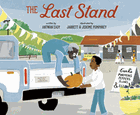
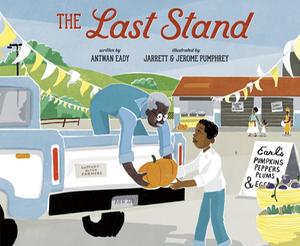
 Antwan Eady's The Last Stand, illustrated by Jarrett and Jerome Pumphrey (The Old Truck), tells the openhearted story of a boy and his grandfather, and pays loving tribute to Black farmers in the U.S. On Saturdays, the boy, who reveres his Papa, helps him harvest fruits and eggs that they place in sweetgrass baskets made by Granny, load their blue pickup truck, and haul it all to the farmer's market where his grandfather has the last remaining stand: "It wasn't always this way. A year ago, there were two. The year before, five."
In his closing author's note, which succinctly illustrates the racism and discrimination Black farmers in this country have faced and the "food apartheids" with which many people still struggle, Eady (Nigel and the Moon) describes the story, in part, as a "love better" to Black farmers and the towns they serve. Here, it's a tight-knit community of regulars at the farmer's market. There's Ms. Rosa, Mr. Johnny, and Mrs. Brown, the latter to whom Papa and the boy deliver baskets of plums on their way home. Readers spot the phrase "SUPPORT BLACK FARMERS" on several spreads--on the bumper sticker on the back of Papa's truck, and on signs that lay sideways in his barn. When Papa is too tired one day to harvest, deliver, and sell, the capable boy does it all himself, and community members load the boy's wagon with gifts for Papa. Eady even gives readers a glimpse into the boy's encouraging future on the final page.
The Pumphreys, who use a mix of traditional (handmade stamps) and digital media to create their illustrations, animate the story with vivid tableaux marked by crisp colors, appealing textures, and uncluttered compositions. Eady fills the text, plainspoken and evocative at turns, with pleasing alliteration and a steady rhythm, making this a good choice for emerging readers (particularly since many sentences are short): "On Saturdays, we harvest, Papa and I. Papa gathers peppers, plums, and pumpkins. I collect the eggs." The watchful boy makes note of signs of Papa's aging, astute and refreshing observations in a world that would rather erase gray hair and wrinkles. The boy, seeing Papa's "black and wrinkled" hands, acknowledges that "each wrinkle tells me a story," as do Papa's slow movements and his "dusty and bumpy" driveway. He knows the stories are worth heeding. The lucky readers who pick up this book can be part of them too. --Julie Danielson, reviewer and copyeditor
Shelf Talker: The Last Stand is an openhearted story of a boy and his grandfather, which pays loving tribute to Black farmers in the U.S.