

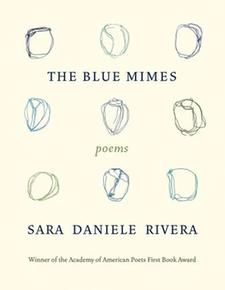
 Winner of the Academy of American Poets First Book Award, Cuban Peruvian poet Sara Daniele Rivera uses language with artistry in The Blue Mimes, moving from English to Spanish with a lovely musicality. The collection of 27 poems opens with an epigraph in Spanish from Alejandra Pizarnik's "La noche de Santiago." The English translation reads, "Close a wound a bell cannot. A bell cannot close a wound," and this reflexive structure reveals much about Rivera's work. She, too, will play with beginnings and endings and inverted repetitions, especially in "Telephone Game," which begins with "I spoke. You. Sound converted and delivered./ We smiled and spoke." At the midpoint, a couplet of lines both begin "Mimic me:" with the second line repeating the first line in Spanish. From there, the poem rewinds, fully in Spanish, and concludes with, "Una luz convertida se entrega en mi cuerpo. Yo hablo. Tú./ Hablamos y sonreímos." More than just a clever trick, this poem reveals a sense of longing, especially with the shift from past tense to present.
A few pages earlier, in the prose poem "Abrigar," Rivera writes, "A line is drawn forward and backward in time. When I wear his coat it leaves my arms numb. Grief makes contact impossible." Grief holds this collection together: personal grief over the loss of loved ones, as well as collective grief over Covid-19 and lockdowns, and over political crises such as the attack on the U.S. Capitol or the separation of children from their families at the border.
In the acknowledgments, Rivera thanks her dad, even though it is his death that colors this lyrical and searching collection. She recalls how her father, who taught her to draw, insisted that it is "the movement, the searching, that matters." In that searching, she tells him, "I... felt you with me, behind every word." Line drawings by Rivera and her father divide the sections, animating Rivera's poems as they dance between grief and healing.
The book's final poem, "Fields Anointed with Poppies," explores the way loss can live in a person, opening with, "I never thought of my body/ as a shrine, but now/ I feel the truth of its doors:/ I carry the archeology of you." It also lives in words: "Hasta tenemos dos idiomas para decirlo: we have/ two languages with which to approximate one pain." Despite the pain, the final line--"And a road continues into open space"--is hopeful and, like this collection, full of life. --Sara Beth West, freelance reviewer and librarian
Shelf Talker: This collection of 27 poems is bursting with sound and light, even as it reckons with a multitude of griefs, both personal and public.