

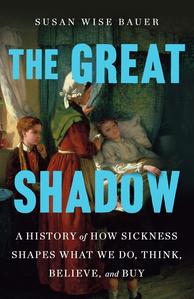
 Susan Wise Bauer's The Great Shadow is an informative and lively survey of the history of illness and of humanity's attempts to combat it. Though much of her account traces the progress that's been made from times when sickness was thought to be a punishment from angry gods, and when society was essentially helpless to fight deadly diseases, embedded in that story is a serious cautionary tale that will temper one's enthusiasm for the belief that medicine can cure what ails us.
Bauer (The Story of Western Science), who holds a PhD in American Studies and taught for 18 years at the College of William & Mary, is a fluid writer who brings to this project the useful background of an intelligent, curious generalist. The Great Shadow proceeds in roughly chronological fashion, launching most chapters with well-chosen, attention-grabbing stories, like a description of Edward Jenner's daring first smallpox vaccination or an account of the death from typhoid fever of Queen Victoria's husband, Prince Albert, to set the stage for a discussion of broader developments in science and medicine.
The task of recounting the history of more than 12 millennia of humanity's struggle with serious illness and death, including the terrifying stories of pandemics that outstrip Covid-19 by many orders of magnitude, is daunting, but Bauer handles it skillfully. She organizes her book around a central theme--the tension between the Hippocratic model of medicine that arose in Greece in the fifth century BCE and the halting journey toward what became germ theory of disease in the 19th century. The former focused not on the illness as such but on the "experience of the patient," while the latter recognized that sickness "was carried by a whole army of microorganisms, each distinct, each causing one particular type of illness" and thus "made sense of contagion."
If Bauer had written her book 50 years ago, it almost certainly would have ended on a note of triumph, hailing the arrival of an arsenal of antibiotics that virtually eradicated a host of deadly infectious diseases. But as she explains in her concluding chapter, with the rise of a new category of antibiotic-resistant infections, the "Great Mortality Transition"--an "unprecedented lengthening of lifespan in the first half of the twentieth century"--was "quick, dramatic, and ridiculously fleeting." What's also disconcerting is that many of the responses--including vaccine skepticism and irrational fear of the "other"--to the Covid-19 pandemic, a contemporary version of a dreaded "plague," mirrored those of earlier, far less enlightened eras. With the enlightenment it offers, The Great Shadow will help anyone gain perspective on some of the critical public health challenges of the 21st century. --Harvey Freedenberg, freelance reviewer
Shelf Talker: Historian Susan Wise Bauer offers a fast-paced survey of sickness and humanity's search for its causes and cures.