

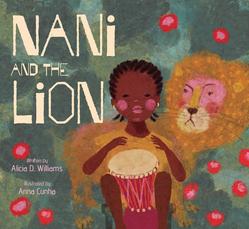
 Nani and the Lion, a story that celebrates courage, community, and the irrepressible force of self-expression, pulses with warmth and musicality. Set in a village shadowed by fear of a ferocious lion, the story, written by Alicia D. Williams (Genesis Begins Again) and illustrated by Anna Cunha (A Story About Afiya, with James Berry), strikes a memorable rhythm between tension and joy, silence and sound.
In this village, everyone tiptoes, for the lion dislikes noise. Animals stay silent; villagers whisper. Yet young Nani cannot resist her drum, whose beats speak "the beautiful language of all the animals." Williams's text carries a percussive energy of its own. Lines hum with rhythm and repetition as Nani treks "to the far-far-farthest part of the village" joyfully playing her drum. Onomatopoeic play enlivens each page, with the "BA-DUMP-BUMP-BUM" of Nani's drums, the "croak-croak gurgles of guttural toads," and "chirp-chirp greetings of bronzy sunbirds." This musical language mirrors Nani's defiant joy, turning sound into her source of strength. Williams also layers the narrative with moments of lyrical description ("mountains kissed the sky" and the lion's mane beaming "as boldly as the sun") that lend the story a poetic quality. When Nani finally drums for the lion, the confrontation transforms into communion: the beast cannot resist the rhythm, dancing until he collapses at Nani's feet in contented exhaustion. Nani's act of bravery is not a triumph over the lion but a turning of fear into understanding through music.
Cunha's illustrations amplify the story's pulse. Expressive sweeps of red, blue, and copper evoke heat, movement, and sound, while playful typography--such as the letters of the lion's "RAWR!" scattered in bold, uneven sizes across the page--gives voice to the noise that defines Nani's world. The compositions balance expanses of open landscapes with intimate character focuses: the small brown-skinned, rosy-cheeked girl standing firm before the golden lion, hands on hips. Cunha tempers any sense of menace, rendering the lion expressive rather than terrifying, ensuring that the story's driving force remains exuberant rather than alarming. Williams's musical prose invites readers to feel the beat as much as read it, and Cunha's dynamic artwork visualizes that beat in color and shape. The result is a picture book that reminds readers, in every beat, that joy and courage share the same rhythm. Like the flowers blooming from Nani's drum on the title page, her music transforms fear into beauty. --Julie Danielson
Shelf Talker: Nani and the Lion, told with rhythm and joy, celebrates courage and resilience in the face of fear.