


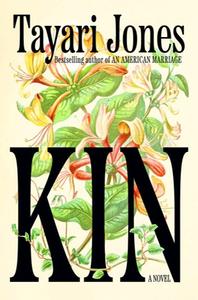
 Tayari Jones (Silver Sparrow; An American Marriage) knows how to write the intricacies of intimate relationships; complex ties within families and marriages abound in her stories. With Kin, she gives voice to two young women, Annie and Vernice, not sisters but "cradle friends" who maintain an unshakable bond across years and distance. Jones also writes a pitch-perfect South, the culture of 1940s Louisiana rolling off the page through sharp-tongued dialogue or when Annie explains the meaning of the word "trifling."
Annie and Vernice grew up without their mothers, raised by their Granny and Auntie, respectively. When Annie runs away to Memphis in search of her mama and Vernice goes off to college in Atlanta, their two paths begin to diverge, physically and socially. Despite those widening differences, they stay connected, understanding that "What you have the same isn't what binds you. Hearts grow strings because of what you know that's the same, what happened to you that's the same."
Told in their alternating voices, Kin shows off Jones's considerable skill through strong pacing and a plot that is emotionally taut without feeling unnecessarily dramatic. Without fail, Jones delivers a brilliant turn of phrase, at turns witty and insightful. After Annie leaves, Vernice struggles to name her deep hurt: "I didn't have the word for this feeling. Abandoned was a school-word, borrowed from Miss Jemison's list. I wanted a word I had used before, some sound hatched from an egg of my own."
Both women struggle to find their way without the guidance of a mother, but both are helped along by women who step in with care, correction, and opportunities to grow. Still, they carry that sense of abandonment and loss into adulthood. Even on the verge of a highly favorable match that would launch her into Atlanta society, Vernice worries what might happen if Annie finds her mother: "Yes, we would always have our childhood in common. But what if Annie repaired the hole in her dam with concrete and straw, and I was still using my finger?" When Annie and Vernice reunite, they show their devotion to one another in ways both empowering and heartbreaking, proving that "Blood alone can't give you kinship." Especially as it spins to its difficult conclusion, Kin feels ambitious and accessible, emotionally challenging without pushing readers away. This is a moving story best shared between friends. --Sara Beth West, freelance reviewer and librarian
Shelf Talker: A beautiful depiction of the power of found family, Kin tells the story of two motherless girls, friends since birth, and their challenges as they face adulthood from very different perspectives.