

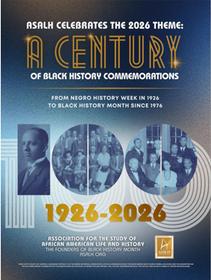
 February is Black History Month, which began 100 years ago as Negro History Week—later renamed and expanded to a month. This year's official theme in the U.S. is "A Century of Black History Commemorations," designated by the Association for the Study of African American Life and History (ASALH). The association was founded in 1915 by Dr. Carter G. Woodson, who launched the annual Black history observations, and has the mission "to promote, research, preserve, interpret and disseminate information about Black life, history and culture to the global community."
ASALH notes the special significance of Black History Month in 2026, writing, "This year, when we are also commemorating the 250th anniversary of United States independence, it is important to tell not only an inclusive history, but an accurate one. We have never had more need to examine the role of Black History Month than we do when forces weary of democracy seek to use legislative means and book bans to excise Black history from America's schools and public culture. Black history's value is not its contribution to mainstream historical narratives, but its resonance in the lives of Black people."
The Association offers Black History Month kits, posters, and merchandise and is hosting the Annual Black History Month Luncheon. This includes an authors book signing event and takes place February 28 in Washington, D.C., and features Karsonya Wise Whitehead.
---
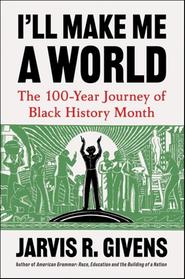 For a detailed look at the evolution and importance of Black History Month, check out I'll Make Me a World: The 100-Year Journey of Black History Month by Jarvis R. Givens, which Harper is publishing on February 3 ($24.99, 9780063478824). In this book, Givens, a Harvard professor and author of American Grammar: Race, Education, and the Building of a Nation, among other titles, traces the history of the Month, drawing on archival research, personal stories involving family and students, and especially the wisdom of Black educators. In the process, he recovers "the legacy of Carter G. Woodson and many others who envisioned Black history as a liberatory force—knowledge that shapes who we are, how we resist, and what we dream."
Givens calls on people "to expand our understanding of Black history to include the everyday lives of ordinary people—the 'workadays' whose stories have long gone untold but form critical parts of Black history... I'll Make Me a World is a call to remember, reimagine, and reclaim an intellectual tradition built by communities well before our time, and to take seriously what is politically at stake in its preservation. At a time when Black history is under attack, this book offers an inspiring vision for how it can still be a source of power, truth, and possibility."
Among the many sources for recommended backlist:
The Center for Black Literature has "a reading list of titles that we and our colleagues turn to for fortitude, inspiration, and uplift." The list includes 58 nonfiction titles, 45 fiction books, 23 poetry titles, and 11 YA and children's books.
Save the Children offers 19 children's books that celebrate Black history.