

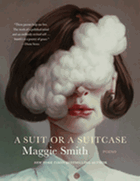
 Maggie Smith's luminous fifth poetry collection, A Suit or a Suitcase, considers mortality, motherhood, and the layers of the self with her signature humor, wit, and keen eye for detail. With crisp, lyrical observations and striking images, Smith (Dear Writer; You Could Make This Place Beautiful) muses on what it means to be a self, how a self may evolve over time, and the odd, potent power of the human mind to both contain and transcend the limits of experience.
Smith's titular poem explores the body-mind connection as she admits the temptation to limit "the me of me" to her thoughts and ideas, and wonders how it might feel to live more fully in her physical body. The collection's subsequent poems reflect on other facets of identity: the layers of self that build up like sediment as a person ages; the "blurry doppelgänger" of a shadow; the "vellum-thin" unfinished selves of the past each person carries. "Beside Myself" examines multiple shades of a common phrase, as Smith tries to become more whole by reknitting the fragments of herself back together, "cinching/ the threads." But Smith also delves deeply into the wonder and whimsy of being both a corporeal and intangible being. In "Self-Portrait as an Incomplete List of Mysteries," she ruminates on who she might have become if she had chosen a different town, a different husband; how both metal and language can become tarnished, yet still retain parts of their original identities; and how her poems "trust me enough to keep arriving." She also ponders, "what rodeo I'm on. I've lost track of my rodeos."
In her memoir and elsewhere, Smith has written extensively about life during and after her marriage, and the identity shifts occasioned by the loss of a central relationship. In "Hope Chest," she contemplates what it means to be given away as a bride, then discarded--"not returned,/ not given back" after her divorce. "I take it back," she declares, naming herself as the hope chest. "Dearly/ I take myself back." In "Foal," she recounts new ways of being in her body and her mind, "now that I have no other heart/ to which I might apply my own." While solitude and memory can be slippery things, Smith is learning to make her peace with both of them, and with the different versions of self, truth, and memory that all (somehow) exist side by side.
Wry and poignant, A Suit or a Suitcase is a thoughtful companion for anyone trying to pay attention to the self, the world (physical and invisible), and the constant surprises of memory and love. --Katie Noah Gibson, blogger at Cakes, Tea and Dreams
Shelf Talker: Maggie Smith's luminous fifth poetry collection considers the mind-body connection, the slippery layers of identity, and the mystery of being both a corporeal and intangible self.