

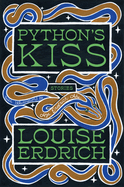
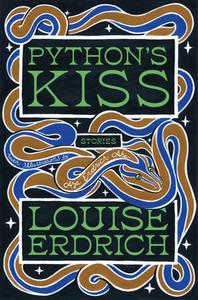
 Louise Erdrich's formidable second short story collection, Python's Kiss, after 2009's The Red Convertible, is a family affair, with detailed black-and-white illustrations by daughter Aza Erdrich Abe; Erdrich also dedicates the collection to Abe, who has designed numerous book covers for Erdrich. Family--particularly relationships between parents and children--takes center stage in many of the most memorable narratives here, whether underscoring unbreakable bonds or exposing horrific betrayals.
In "Wedding Dresses," an aunt shares sanitized summaries of her four marriages with her beloved 11-year-old niece, but reveals far more intimate, often devastating details with readers. In "December 26," a mother desperate to save her adult son forced on the run for potentially fatal choices will do just about anything to save him. Chosen family proves even more supportive and nurturing in "Amelia," about a teen determined to escape her small town, encouraged and enabled by an older bachelor who recognizes her potential for so much more. Erdrich chooses speculative fiction to explore noncorporal relationships: in "Domain," a woman transitions into the afterlife intending to terminate her father, who let her young son die; in "Asphodel," Evlin must repeatedly sentence her daughter, Caroline, to death in accordance with her afterlife contract--but this time, Caroline 8,037 forcibly chooses to live. Erdrich presents the undead in "Borsalino," which features a woman who meets an irresistible Venetian thief who, 16 years later, saves her from the manipulatively charming husband determined to kill her. Animals appear both to haunt and to help humans: in the wrenching "Python's Kiss," a young girl shows singular kindness to her grandparents' guard dog, Nero, a prisoner forever denied affection and freedom; a feral cat emerges as the hero in "The Feral Troubadour" when she attacks and manages to trap a would-be thief in a bathroom window.
Among the 13 stories gathered here, seven were previously published, with five initially appearing in the New Yorker. Erdrich, who has won both the Pulitzer Prize and National Book Award, uses short stories as an opportunity to experiment with various content and forms with unfettered, effortless ease. Several stories in Red Convertible, for example, morphed into novels, including the titular story (originally published in 1981) that became 1984's Love Medicine, and the penultimate "Future Home of the Living God," which became a novel of the same name in 2017. Lucky readers could and should consider this collection as a prescient gift. --Terry Hong
Shelf Talker: Louise Erdrich's second story collection presents 13 intriguing narratives, many of which poignantly, memorably explore the complicated relationship between parents and children.