

|
|
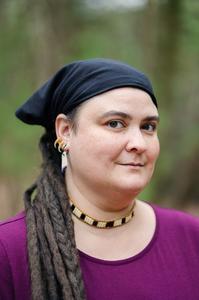
| credit: Angelina Rose Photography | |
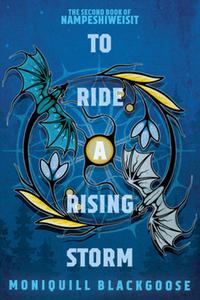
Moniquill Blackgoose is the author of To Shape a Dragon's Breath, which has won both the Nebula and Lodestar Awards, and its sequel, To Ride a Rising Storm (Del Rey Books, January 27, 2026). Her Nampeshiweisit series follows a young Indigenous woman and her dragon. She began writing science fiction and fantasy when she was 12 and hasn't stopped writing since. She is an enrolled member of the Seaconke Wampanoag Tribe and a lineal descendant of Ousamequin Massasoit. She is an avid costumer and an active member of the steampunk community. She has blogged, essayed, and discussed extensively across many platforms the depictions of Indigenous and Indigenous-coded characters in science fiction and fantasy.
Handsell readers your book in 25 words or less:
Indigenous girl acquires a baby dragon and is forced to leave her insular community to attend a colonizer-controlled dragon riding school in steampunk alt-history New England.
On your nightstand now:
Currently reading: Beyond the Glittering World: An Anthology of Indigenous Feminisms and Futurisms, from Torrey House Press. I just finished reading A Snake Falls to Earth by Darcie Little Badger and enjoyed it very much! Next on my reading list is A Psalm for the Wild-Built by Becky Chambers.
Favorite book when you were a child:
Watership Down by Richard Adams--it was a far more interesting and complicated story, with more going on in it, than most of the media that was presented to me when I was five or six. A lot of media intended for children is very "dumbed down." Watership Down had conlanging and expansive lore. It talked about political systems, acceptance of mortality, religion, and the importance of storytelling. Also everyone was a bunny.
I have written whole essays about this.
Your top five authors:
Octavia Butler, Ursula K. Le Guin, Terry Pratchett, Robin Wall Kimmerer, Naomi Novik.
Book you've faked reading:
Anna Karenina by Leo Tolstoy and The Old Man and the Sea by Ernest Hemingway--apologies to my professors at the time, but both books bored me to tears.
I got A's on the papers anyway. Thank you, CliffsNotes.
 Book you're an evangelist for:
Braiding Sweetgrass by Robin Wall Kimmerer--one of the best books ever to illuminate the very different worldviews of indigenous (sustaining) versus colonizer (extractivist) cultures. I quote this book all the time.
"In the Western tradition there is a recognized hierarchy of beings, with, of course, the human being on top--the pinnacle of evolution, the darling of Creation--and the plants at the bottom. But in Native ways of knowing, human people are often referred to as "the younger brothers of Creation." We say that humans have the least experience with how to live and thus the most to learn--we must look to our teachers among the other species for guidance. Their wisdom is apparent in the way that they live. They teach us by example. They've been on the earth far longer than we have been, and have had time to figure things out." --Robin Wall Kimmerer, Braiding Sweetgrass: Indigenous Wisdom, Scientific Knowledge, and the Teachings of Plants
Book you've bought for the cover:
Quozl by Alan Dean Foster, which has been featured over in r/badscificovers.
It is exactly the story that the cover advertised and I was delighted. I wish we could return to sci-fi and fantasy covers that are like that.
Book you hid from your parents:
I never had to do this; I was allowed to read whatever I wanted. I read Pictorial Anatomy of the Cat by Stephen G. Gilbert when I was five.
Book that changed your life:
Every book I've ever read has changed or revealed something about me; that's the nature of art! I am clinically hyperlexical and was reading fluently by age three. I think that I've been shaped by reading/having read to me (by my mom) a lot of material "not specifically intended for children" when I was a small child; the whole Chronicles of Narnia series by C.S. Lewis when I was about six, The Hobbit and the Lord of the Rings series by J.R.R. Tolkien when I was eight--both after asking for more information regarding animated adaptations of those works.
Favorite line from a book:
"Westerners are fond of the saying 'Life isn't fair.' Then, they end in snide triumphant: 'So get used to it!' What a cruel, sadistic notion to revel in! What a terrible, patriarchal response to a child's budding sense of ethics. Announce to an Iroquois, 'Life isn't fair,' and her response will be: 'Then make it fair!"--Barbara Alice Mann, Make a Beautiful Way: The Wisdom of Native American Women
Five books you'll never part with:
After reading a book and really enjoying it, my first action is usually to give it to a friend who will also enjoy it. I actually don't keep many physical books around in my house, and those that I do are usually because they're out of print and thus hard to replace (not necessarily because they're my favorites). I am a library patron more often than a bookstore patron.
Book you most want to read again for the first time:
I do not experience this desire. I don't want to "read again for the first time"; I want to reread with deeper understanding. I never want to lose or forfeit knowledge/experience. Surprise and discovery are nice, but they're not worth ignorance.
Books that made you want to become a writer:
I cannot remember ever NOT being a writer, but around age 12 it clicked for me that I could write whole novels and publish them. At the time, I was reading a lot of Anne McCaffrey--Dragonriders of Pern and Acorna series, and also K.A. Applegate's Animorphs. I thought to myself, "I could write stories like this!" And then proceeded to spend a couple of decades getting better at telling stories well.