

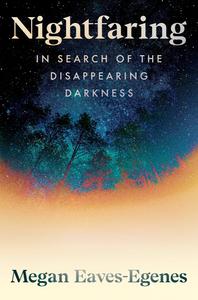
 At a moment in which the glow of screens is rivaled only by the ever-present "skyglow" of municipal grids, the experience of a true night has become nearly a historical relic. In Nightfaring: In Search of the Disappearing Darkness, Megan Eaves-Egenes takes readers on a restorative journey into the few remaining pockets of the planet where sundown still signals the appearance of stars. Her focus is the profound, creeping loss of the nocturnal world, a phenomenon often accepted as merely an aesthetic casualty of progress, but which she argues is a fundamental disruption to the nature of humanity. She presents light pollution as greater than simply an environmental metric; it's a sensory dazzling that has effectively desensitized people to their place in the cosmos, turning their gaze inward instead of out into the infinite.
Eaves-Egenes writes with the authority of a childhood spent outdoors stargazing "in the middle of nowhere" with her father in New Mexico and a career spent traversing the globe. As a former editor for Lonely Planet, she has honed instincts for what is peripheral or might be overlooked by others. This sensitive perspective allows her to bridge the gap between the rural darkness of a lightless room at a monastery in Germany and the artificial twilights of our densest metropolises, like London, where only 10 out of thousands of stars might be visible on a clear night.
Eaves-Egenes treats darkness as a physical substance, a presence with its own distinct textures, sounds, and even scents. She goes beyond the visual spectacle of the Milky Way to delve into the tactile experience of moving through a landscape where eyes cannot be relied upon. She describes the heaviness of a moonless sky and the ways that other senses--hearing the shift in wind, feeling the drop in temperature--sharpen when the light is absent. Her prose embodies the sensation of adapting to the darkness; it begins with a sharp, lucid critique of modern industry and gradually softens into a lush, meditative rhythm that feels like a late-night conversation quietly held under a vast canopy of stars.
Like The Darkness Manifesto by Johan Eklöf and The End of Night by Paul Bogard, Nightfaring explores the idea that humans have a biological and psychological right to darkness. Eaves-Egenes convincingly demonstrates how our circadian rhythms and our capacity for wonder are being eroded by the orange-hued constancy of the 21st century. Nightfaring will resonate for anyone affected by persistent light fatigue, as well as for the amateur astronomer and the environmentally interested looking for a fresh perspective on conservation. It's a call to reclaim rest, silence, and sense of scale in a world that refuses to turn off the lights. --Elizabeth DeNoma, executive editor, DeNoma Literary Services, Seattle, Wash.
Shelf Talker: Nightfaring provides a moving argument for navigating the way back to the majesty and intimacy of the shadows, showing that profound discoveries are often made in the dark.